Sunday, May 04, 2008

The Gathering - Book Review by Ann Enright - A Very Special Novel

This is a very special book and I am sure a lot of people would find it too dark, gloomy, scattered and disconnected; this is true for sure, but I still really enjoyed it.

The Gathering is a about Veronica's loss of her brother Liam, her very special brother in a large Irish family of twelve. The figure of the grandmother is dominant throughout the entire novel, as a beautiful yet aloof woman. The grandmother histories with three different men, a brother who has gone mad, a devoted husband and, more prominently, a shadowy admirer friend of the husband are revealed gradually as we go through the novel. Perhaps, more accurately, they are revealed as Veronica searches her mind and whatever records she can find making sense of the loss of Liam.

Veronica is in deep pain and sadness at the death of her brother, she is tormented by it to her very core; her life is truly in tatters. The grandmother figure is there, not necessarily being judged fully, and not presented as a complete well rounded person but as Veronica delves deeper into her sorrow she understands more and more about Ada. Liam's figure is also revealed, mostly as a sad lost alcoholic man who had trouble making something out of his life.

The portrayal of the Veronica's own mother is more distant, deliberately cardboard like, a child bearing machine with weakening memory and limited interests, a small banal dependent person to be loved, cared for and somewhat disdained.

Veronica looks at her entire life, her husband, he daughters, her various surviving brothers and sister and anguishes at the loss of her brother and at her own life.

Many reviewers of the book described it as a look into a dysfunctional Irish family, in a sense it is, but this was not the overwhelming feeling I had reading it. For me, it was Veronica's wading deeper into her mind and opening the floodgates of memories to make sense of the loss of Liam, of their estrangement or at least distance as they got older, of the distance from her own youth. The beauty of the language and the intelligence with which the reader is moved along make for a brilliant, reflective, slow meandering, and ultimately a very rewarding read.


Sunday, April 06, 2008

Designer Partners

On the Sixtieth Anniversary of the Creation of Israel …Is it time to reconcile?

The Israeli and the Palestinian peace camps would love the luxury of shaping the agenda of each other; they both yearn for a peace partner who would make their job easy, who would help them sell peace to their war-weary and hate-filled folk. Yet they don't have the luxury of designing the opposite side to appeal to a larger percentage of their respective populations. The Israeli peace camp remains oblivious to the colonialist aspects of Zionism and simply wishes for all the pre 1967 atrocities and suffering to be simply washed away and forgotten, just like what happened with the Native American or African slave trade centuries ago. The Palestinian peace camp wants a far more outspoken Israeli peace camp that is willing to admit the past wrongs.

The Israeli peace camp needs Palestinians who can talk about the Jewish suffering and offers affirmation that Israel has the right to exist. Yet virtually all peace advocates on the Palestinian and Arab side feel to their bones that Israel never HAD the right to come into existence in 1948. They argue Israel HAS the right to exist now but did not have the right to come into existence in Palestine in the first place. Had Zionism opted for a homeland in an alternate place it would have had that right, had it been empty of an indigenous native population. The compromise secular Zionism made to attract the religious elements was Palestine ...that compromise will forever mean the issues of rights of the natives will remain and Zionism dream of a Jewish state forever is threatened. So in short, the basis under which Arab and Palestinian peace advocate support Israel's right to exist now is the historical suffering for both people and practical thinking knowing that any other option will only lead to more needless displacement and suffering. The Palestinians can never buy into Zionism!

Most forward-looking open-minded people have a great deal of trouble with the concept of ethnic democracy. If a US group was to advocate putting a limit on the numbers of Hispanics, Chinese, Arabs or Jews say in California or Florida so that these places remain predominantly Anglo White and Christian we would all be up in arms accusing them of racism, bigotry anti Semitism and what have you. As it happened California is already majority non-white! What moral, legal or other basis would one have for claiming that 1948 Israel has to remain forever predominantly Jewish? I seriously doubt that any sane worldly Israelis who want to think of the world as their oyster really want a large ghetto for a country. It is hard to envision the European treaty that offers Israel membership to the EU restricting the number of gentiles who can live & work in Israel. A good guess is that the Israeli peace camp needs this hallow argument to help to convince others who maybe fearing that they will overwhelmed into a being a minority yet again. It is not difficult to understand this position. The Israeli peace camp clings on to the notion of a Jewish state forever because it still clings on the glories of 1948 and the courage and commitment of the Sabra generations.

Yet, if we look at the other side of the equation, which is how can one help the Palestinians peace camp gain more momentum, it has to be based on a practical way forward NOT principles. A principle like a Jewish State forever makes it hard to recruit people based on practicality and reconciliation. It invites the very logical reaction of rejection; on the grounds of history, morality and future looking multi cultural borderless world. Maybe we can find more willingness to agree guarantees of a Jewish state for the next 50 years just as China guaranteed Hong Kong way of life for 50 years than a guarantee based on a principle enshrined in Zionism.

Yet the Palestinian and Arab peace camp needs to articulate to its own people its views about its support for Israel right to exist. In an Arab world full of maps that show no evidence of Israel and newspapers that continue to shy away from the mere mention of Israel, opting for the “Zionist Entity” instead, the Arab peace camp must talk of the many generations of Jews born and raised in Israel with no other home. It must also articulate its rejection of the often-rampant discrimination against minorities in the Arab World. The Arab and the Palestinian peace camps must be more outspoken in rejecting violence and in offering commitment to genuine peace. It needs to help the Israeli peace camp convince its people that the Palestinians and Arabs want peace because they believe in peace and not because of the strength of Israel, not because of the fear of home demolitions, collective punishment or the long brutal arm of the IDF.

The sad thing about the Middle East conflict is that the extremists on both sides offer each other far more help than the peace advocates do. The Israeli hardliners could not have hoped for a better designed nemesis than Hamas & Islamic Jihad and vice verses; they help each other convince their target audience that peace is not possible and violence is the only way; designer enemies indeed! Shame that the peace advocates struggle with the lack of designer models.


AA

6 April 2008

Thursday, March 20, 2008

Salata Baladi: Egyptian Director Breaks Taboo by Filming in Israel


The relationship between Egypt and Israel is what you might diplomatically call "thorny." While the two nations have officially been off each other's backs since the 1979 Camp David Accords, there's still plenty of resentment and outright discrimination when it comes to their movies and other artistic products. Many Egyptians take the position that Israel should be boycotted altogether until the conflict with Palestine is resolved -- so, you know, don't hold your breath.

We've already talked about how the Israeli film The Band's Visit was banned from the Cairo Film Festival and the Middle East Film Festival in Abu Dhabi for the sole reason that it was an Israeli product. The fact that the movie is a buoyant comedy about Egyptians and Israelis learning to get along was overlooked by the festival programmers, who are evidently immune to irony.

Now a new scandal has arisen: Egyptian director Nadia Kamel has made a documentary and shot much of it in Israel. What's more, the film is actually about the mixing of Egyptians and Israelis, as it follows Kamel's attempts to reunite the long-estranged parts of her family that include Egyptian Muslims, Israeli Jews, Italian Catholics, and more. Kamel's on-camera family reunion was probably the last chance for the older generation to see each other before they die.

Salata Baladi (House Salad) premiered at the Locarno Film Festival in Switzerland (a neutral country, fittingly) and then played last week at the Middle East Film Fest. Those screenings happened without incident -- but they weren't in Egypt, either. The doc will screen again this week as part of the Cairo Independent Film Festival, and according to the Variety article that brought the film to my attention, Kamel is bracing herself for a possible backlash among her Egyptian peers.

You can learn more about the film at the filmmaker's blog. I hope Egyptian audiences find it thought-provoking rather than infuriating. After all, shouldn't family ties transcend religious and political differences? I mean, I've long since forgiven my brother for being a Republican.

Tuesday, February 26, 2008

Hamas Invasion of Egypt!

After several weeks of travel, I am finally back home. I had a lot of interesting feedback to my essay about my visit to Tel Aviv and Jerusalem. Most interesting was the change in the feedback I had from some of my friends & family from Egypt. The email feedback was generally negative or just sarcastic about me going and about my pro normalization comments. By the time I made it to Alexandria and Cairo the Gaza / Egypt crossing had taken place.
Sadly in a way for the Palestinians, and fortunately in a way for the Egyptians and Israelis, Hamas had done what 30 years of peace could not achieve. Most Egyptians I met for the first time, since the first days after the Sadat visit to Jerusalem, looked at Israelis as normal people and some used words such as "the right is on Israel” ..or “what can they do?" Even very religious people were re-examining the recently normal hatred of all things Jewish and discovering references in Islam and in Islamic history about friendship and harmony with Jews. The same people who sent me disapproving emails just a couple of weeks before were now asking me more what Tel Aviv was like, Did you really go running on the beach and in the streets of Tel Aviv? Did people know you were Egyptians? Etc.
The Egyptian press was strange; cruel in a way, in stirring up anger at the ordinary Palestinians, but also fair in reminding people of the suffering of Egypt for the Palestinian cause. Some editors referred to the “Hamas invasion of Egypt”, others were full of praise of Sadat, “the hero of war & peace” and drudging up decades old anger at the Palestinians by reminding the readers of the joy of Arafat and the Palestinians at the news of the death of Sadat and the fact that no Palestinian leader has yet showed the courage and decency to visit Sadat’s grave.
Essam El Areean of the Brotherhood wrote in one of the opposition papers in support of Hamas and clearly felt the need to articulate the whole case for Hamas and what it is doing in Gaza, both in terms of rejecting Abbas’s approach for peace with Israel and taking control. The fact that he had to repeat the argument put forward verbatim by Hamas made me wonder if they were feeling that they were losing the average Hassan on the streets of Cairo.
For a long time advocate of peace and reconciliation, it was really good to see the change in Egypt. Sadly, as a supporter of the rights of the Palestinians I was also sad to see that anger at Hamas was turning Egyptians into anger at the Palestinians as a whole.
It is hard for me to characterize the opinion in Egypt from very few days in Cairo and Alexandria. But I don’t remember anything like this in Egypt for many years.
Anyhow, always fun to be in Egypt, but great to be back in the snow!
February 26, 2008

Sunday, February 24, 2008

Scattered thoughts from the land beyond Sinai

An emotional journey with many fleeting thoughts about what to expect … a twinge of fear, of understanding, of anticipation and a touch of sadness or resentment at those rejecting my desire to come and see for myself. So this is the other side, this is where the Phantoms and the Mirages were taking off back in 1967!

Recognition …Right to Exist …was it right to come into existence then? …right to exist now?

Somehow I feel that the issue of recognition is split into different questions that need to be addressed separately. For me recognizing Israel today is self evident; it is there and has been for several generations. Today maybe a million or more have already been born to parents who were born in this land, to deny Israel’s right to recognition is clearly delusional ….regardless of how one (I) feels about how Israel came into existence, it does now, and must be recognized.

More than anyone else the Palestinian Israelis have come to terms with the reality of Israel’s existence and are living within the system and are working to better it.

Sadly, I don’t see Israel reaching out to be accepted. Once it did maybe, perhaps it got tired and it doesn’t anymore …did it ever really? Israel’s brutal practices seem to feed the flame of hate rather than yield the desired result of acceptance… why does it persist? I think of those who know everything there is to know about the Jews and have never actually laid an eye on one let alone spoken to one, make up the majority of those debating normalization or recognition. Sadat was truly a brave visionary man, may God forgive his many sins. What he did was truly remarkable, what was going through his head as he landed here, I wonder?

Land of the rejected and the rejecting …the images I have looking at the people as I run on the beach and on the streets of Tel Aviv! There are some people who are here because they can’t be anywhere else. The Hasidic Jews are home here; they can be easy targets for discrimination and have suffered over the centuries ….don’t they get hot in this stuff? I think I must have run onto the stage set of "Fiddler On The Roof” by the beach ….. or am I just too hot in this cold wave?

Yet, there is also the elite that is accepted everywhere ..in New York, in Paris. Some places in Boston look and feel more Jewish than Tel Aviv! The elite who are clearly not rejected anywhere , some of whom are dead set against accepting the other …both others I reckon …. Are they doing this out of compassion for the rejected ones? A good deed! Or are they simply supremacist in their own way? A bit of both, I guess!

Then there is the truly religious amongst those elites, as always I am not so sure if it is adherence to a faith or loyalty to a nationalist movement that fills a void! Funny, I waited in the extra security room at the Airport with a new immigrant in shorts, yarmulke and iPod! Oh, the battle between the Law of Return and the Right of Return is surely one sided.

The “Rejected & the Rejecting” may help me make sense of this! ….and we have our own rejectionists too …what fun with the one verb!

The Weather in Israel Today

The Jerusalem Post is full of complaints about incitement and of Israel being rejected by Arab and Muslim countries, not even being shown on the map. Yet its own weather map on the back page shows the map of historic Palestine plus the Golan with just some marking for Gaza! Why the mark for Gaza but nowhere else? The pot is calling the kettle black, I wonder.

“What good is the IDF if it can’t stop the Qassam Rockets?” cries one of the headlines in The Jerusalem Post! There is something very macho about Israel. An out of place and out of date sort of feeling that overwhelming strength is the key to safety. America is learning more from the four year experience occupying Iraq than Israel has done in many decades of dominating and occupying the Palestinians.

Focus on Israel not the occupation!

I Saw The Wall, visited and prayed at Al Aqsa and I saw the settlements and the house of the zealots, in the old city, with the many Israeli flags. But I did not want my trip to be focused on what Israel is doing to the Palestinians of the West Bank, I didn’t want the impressions of the checkpoints, the oppressive wall, most definitely, it is not a fence, this is one big ugly wall. I wanted to see the pre 1967 Israel, its look and feel, what are the people like, are they European? Mediterranean? vulgar and rude as I heard from another Egyptian? Intellectual? Cool & hip? I admire the guts and courage of Sana Hassan coming to Israel even before Sadat. I should have packed Hassan’s Enemy in the Promised Land as my guide book; it would be funny if it were to be sold as such!

What do the road signs look like? I find Arabic is really the third language after Hebrew and English. It is strange that almost all old Palestinian names are suppressed; I understand the use of biblical names but when a village once existed with a certain name why come in and substitute a very European name. Israel needs to come to terms with its own history, the good and the bad! The different monuments on the highway between Tel Aviv and Jerusalem and the History of Israel in the Welcome to Israel hotel book all made me think of George Orwell’s 1984. Yet I could not reconcile this 1984 feel about the place with what must be truly remarkable freedoms even by US standards!

The Pess-optimists … The Palestinian Citizens of Israel


Most interesting for me are what I call, perhaps wrongly, Palestinian Israelis, what the Israelis call Israeli Arabs and what are often referred to as the 1948 Arabs or Arabs of 48! The Palestinian Israelis come across are very welcoming. First, they assume I am a local Israeli Jew who speaks Arabic but then when they find out I am of Egyptian origin they shake my hands warmly, offere tea or coffee. At a gas station, one says ”…we have two Egyptians living here, you should come and see our village…”. This is close to Nazareth; where several Palestinian Israelis were killed by the Hezbollah bombing last year!

Collaborators …the whole lot of them of course not, I highly doubt it; Haifa and other places were already integrated for decades and in many cases people were highly educated and more affluent. I think of Emil Habibi’s wonderful book “The Pessoptimist ~The Secret Life of Saeed” Habibi portrayal of the early years of Palestinian life in Israel through the eyes of a Palestinian “Candide” who was actually a collaborator! Habibi won the Israel prize for literature for his work. I guess the worst and best of all possible worlds!

The different languages one hears American English, Russian, Hebrew, French, Arabic … Almost all the Israelis I meet have been to Sharm. The Palestinian Israelis consider visiting Sharm as a visit to Egypt, the Jewish Israeli refer to it as in Sinai, not Egypt …Oh this still? It is a bit disturbing but, I suspect, just an innocent oversight, not a deliberate statement about Sinai not being Egypt.

The comfortable integration between Palestinians and Israelis in some places, even in the old city is remarkable. As I have dinner at Haifa and look around me I think; are they worlds apart or almost the same people?

Orthodox and those in the black robes!

The orthodox Jews with the Yarmulkes and the many many variants of the “Hasidic” Jews with their different costumes, the long black robes, the ties, and the different types of headwear…something unreal about the movement in flocks. …..The imposition of the Shabbat’s rules on secular Tel Aviv seems unnatural to me! It reminds me of stores closing at prayer times in Saudi Arabia …what a strange thing to remember here?

Constant sound of gunfire!

The beautiful beaches of Tel Aviv are destroyed for me by the horribly noisy racquet ball games, sounding like bullets being fired, I wonder if bullet sounds are relaxing for some? Such a strange aspect of a city and country that is always on edge!

The same exact games are very popular on Alexandria beaches but with a less noisy ball or just more background noise, or just played less vigorously? I wonder to myself as I close the windows.

Diesngof Street,

I walk by the same exact street corner that had 3 or 4 bombings; I see two memorials for the victims of the suicide bombings! I am told the trees had to be cut down in a “box” form to avoid body parts flying all over the high tree branches. What a dreadful image, I close my eyes and turn around.

In the 90’s many west bank Palestinians worked in Tel Aviv, not just as laborers but shopkeepers too! Tel Aviv feels a lot like Alexandria before the overcrowding, perhaps a cross between the Mamoura and Semoha districts of Alexandria.

I wonder to myself: is Israel comfortable with itself? Is it any more or less comfortable than anywhere else?

Temporary Permanent Residents

Those Palestinians in the Triangle, not sure what Triangle but that is what the area around Jerusalem is apparently called! They carry a certain color ID card which entitles them to temporary permanent residence, whatever that means.

What will happen to the people that Israel acquires as part of its eventual settlement with the Palestinians? Will they become like the Palestinian Israelis or will they integrate less?

Are there any territories actually occupied and not disputed …apart from Gaza which is really neither, now at least?

Aren’t we all temporary permanent residents after all?


31 January 2008

Tribute to Benazir

I have always had some conflicted feelings about Benazir Bhutto. She always came across to me as a strong woman who spoke well and very eloquently but I always felt that there were truth to the allegations of corruption against her and always felt that she was most of all driven by power, the desire to rule and to be in control. The father to son or daughter family lines in India and Pakistan have always bothered me, I find it strange that in these two republics even opposition leadership pass through familial lines. There is something fundamentally very arcane and undemocratic about Nehru family three generations and now ready for the fourth controlling the Congress Party and similar with the Bhutto family and the People Party.

In Egypt after Nasser we as a nation, I think, have become so cynical that it will take few more generations before people ever allow themselves to love a leader for real again. Egyptians loved Nasser, well at least the vast majority did and after the 1967 disaster and all the scandals of his era and all the torture and corruption the idea of us ever trusting someone to that point again feels very unlikely! We in Egypt are most ashamed of being taken for fools, we are not naive, we know better and hence no more leader worship, never again! We look with scuff at those silly Asians who adore Bhutto or Gandhi or what have you, we are smarter than that, we know better, we are not fools, no more!

Yet, as I watch news reports from Pakistan and read about the mass sorrow over Bhutto's death I am more conflicted. This woman was certainly a very brave one, she knew the dangers, she knew she was a bigger enemy for the extremists and for the State / Junta than perhaps anyone else. She did not hide, she was out there with the people, her poor miserable nation, dirt poor and with no hope ..she was amongst them leaving her kids, her three relatively young kids away in Dubai while she did her thing in the dusty smelly villages and cities of Pakistan.

Was she power hungry? Perhaps! Was she corrupt? Very likely? Was she self serving? Probably! Did she deserve be a leader just because of her family name? Probably not!...But these are not the only questions to be asked! Benazir Bhutto could have had a much easier life, yes she was driven by some many different motives but she has always spoken out against extremism, always shown courage, exemplary courage in fact and for that she ultimately paid with her life!

May the sole of Benazir Bhutto rest in peace, may God forgive her and may God help her family cope with their loss and May God help the long suffering people of Pakistan and may the end day for this horrible extremism be near

December 29, 2007

Tuesday, August 07, 2007

Once Upon A Country ...Once Upon A Peacemaker - Book Review - Sari Nusseibeh

This is a truly important book for anyone wishing to understand fully the Arab / Palestinian - Israeli conflict. It sheds tremendous light on very important events, thus far not fully presented from the Palestinian side, especially that of the non rejectionist Palestinian camp. Sari Nusseibeh is a truly visionary man with tremendous courage and is a highly gifted activist and indeed very clever politician despite his own denials.

I have thoroughly enjoyed, and was often moved by, the first half of the book which dealt with the history of Nusseibeh's family and contained his even handed description of the events leading to 1948 and all the way through the 1967 war and his subsequent return to live in Palestine with his British wife. Nusseibeh's portrayal of the lives of the Palestinians between the wars of 1948 and 1967 was very helpful.

In the second half of the book Nusseibeh hammers in, over and over again, on the tacit unspoken alliance of the extremists on both sides and shows how Israel supported the creation of Hamas as a counter weight to the Fateh and PLO. He coherently and very persuasively presents the thought process that he went through to move from the one state solution to the two state solution and demonstrates very effectively the threats that prolonging the conflict would cause to it.

Nusseibeh was often right at the center of things or at least presents himself as such; we see him as a leading figure in standing up to the Israelis and to the Islamists, we see him as the key engine behind the first intefada, or uprising, and we see him winning the respect and approval of Yasir Arafat. In this, second, half, this book moves from being a truly exceptional account of the personal and family history more into an aggrandizing politician's memoir. This should not reduce nor detract from the tremendous personal sacrifice and commitment Nusseibeh made to his cause.

I have heard of the peace work of Dr. Nusseibeh and read some of his articles and interview for some years and while I admire him more than any other Palestinian public figure, this book troubled me in a number of ways. Unlike the other three Palestinian memoirs, originally written in English, that I have read (Gada Karami, Fay Kenfani & Edward Said) Nusseibeh sought to justify every action he has ever taken, to defend his various historic positions and to settle the scores with those of differing views. Most unlike the other three biographies, the book contained virtually no retrospective sole searching whatsoever and important topics such as his obvious passion and skill for politics vs. his academic eccentric persona were packaged for the purpose rather than thought through. Nusseibeh repeatedly simply presented himself as the reluctant professor, yet left us wondering about his very savvy organizational, political and survival skills. He seemed to know exactly how to deal with wily old Arafat, Hamas, the Israeli intelligence and the various factions of the PLO yet retain the freedom to advance his own agenda as well as build important relationships with Israelis.

The tremendous heights, in which, Nusseibeh holds his father, a former Governor of Jerusalem, ambassador and member of cabinet gives the feeling of an immature biography lacking in the distance to be objective. Indeed the first half of the book contains rework of the some of the father's own unpublished memoirs. Obvious points such as the father's commitment to an idealistic form of pan Arabism, albeit non Bathist and non Nasserist, and Nusseibeh own movement into being Palestinian nationalist, seeing Palestine being in natural alliance with Israel did not cause him to reflect further on the role and thinking of his father. A respectful critique and contrast of the views would have enhanced and not hindered the understanding of his father and need not be disloyal to his memory.

Most grating perhaps is the competitiveness displayed with other Palestinian peace advocates and the various attempts at discrediting them. This was particularly evident in describing the efforts that led to the Geneva Accord, which Nusseibeh referred as the plan by the name of the Israeli negotiator, thus marginalizing the Palestinian partner. At some point Nusseibeh clearly fell out with Hanan Ashrawi and Dr. Barghouti, both articulate advocates of the Palestinian cause and for peace and coexistence with Israel, he made his disdain of them very obvious and has not troubled himself to analyze their positions even in retrospect.

Wednesday, July 25, 2007

1984 on the Mediterranean - Book Review of In the Country of Men by Hesham Matter

I heard about this book from an interview of Terry Gross on NPR's Fresh Air with the author Hisham Mater. In the interview Mater talked of his own life experience as a boy watching interrogations on Libyan TV and the eventual detention of his father and the exile of the family first to Egypt then England. The author came across as a very thoughtful and articulate, his description of his experience as a child coming so close to the horrors of torture clearly left its mark on him.

In the Country of Men, belongs to the semi fiction genre, it is based on real events witnessed first hand by the author but clearly the author let his very creative talents take over and weave a number of other interesting patterns on the same basic setting of Libyan social and political life in the Seventies.

Hot Mediterranean summer days, lots of white sand and the beautiful blue Mediterranean, a nine year only child living with a mother suffering from depression and alcoholism trying to make the most of a bad marriage. A father, who is somewhat remote and a bit caricature like is a businessman turned activist obsessed with making Libya a better place. Libya is very much right out of 1984 with much of the horrors, brain washing and denials and a great "Guide" too.

Mater's developed his own child character and that of his mother's superbly into complete multi dimensional human beings. The cruelty and contradictions in the child were masterfully portrayed. Also his sense of place and time is remarkable, Mater makes you virtually taste the beautiful delicious mulberries or sense the heat burning your feet from walking in the hot afternoons to the Tripoli beach.

The disappointing parts of the book were just two aspects; the limited development of the character of the father who was clearly central to the story. While it may have been Mater's intention to paint a picture from the eyes of a 9 year old and as a result a sketchy picture of the father may have been appropriate, this somehow jarred with me as the narrative was that of a more mature adult reflecting back on childhood days. This maturity came across in many ways but fell short when discussing the father. The second disappointing aspect of the book was the relationship with Karim, the childhood friend. Mater was brilliant in the way he dealt with the Karim relationship throughout the book but somehow appear to have felt compelled to tidy things up for a semi happy ending.

The interview with Terry Gross, revealed the true experience of Mater's life and the real life ending was far worse than the one he offered. Perhaps this would explain Mater's need to retain a distance from his father, even in a work of semi fiction and the relatively rushed ending of the book.

I strongly recommend this book as another beautifully written work in English with a strong Arab Mediterranean sensibility.

Saturday, June 09, 2007

Reflections on Muslim Wake Up byline

This article was the very last article I wrote for MWU, it was never published. The site was taken down around this time. 

Reflections on Muslim Wake Up byline
Remove “prayer is better than sleep”

I love Muslim Wake Up, right from the time it started I felt that there is finally a place for me. To me Muslim Wake Up is a place for those who identify with their Muslim identity and heritage, want to celebrate their faith. I find joy in reading and observing the writings and comments of secular Muslims, progressive Muslims, spiritual or Sufi Muslims, agnostic Muslims, confused Muslims along with those of more traditional orthodox Muslim. For me, Islam is a journey of searching and learning and much of the contemporary main stream Islamic discourse is full of certainty; no search needed.

The “prayer is better than sleep” slogan or byline of MWU has always troubled me. I love the notion of waking up; the Islamic World has been asleep for centuries. After centuries of great contribution by Islamdom in science, philosophy, thought and much achievement towards human advancement, stagnations, reversals, and eventually rot have taken over. Islamic jurisprudence moved from being an example of sophisticated legal code with real examples of beauty and turned into cheap fetwa pronouncements dispensed left and right out of ignorance, for political gains or popular appeasement.  Waking up indeed is needed ..but what do we need to do when we wake up ..think, search, debate, build or pray?

I reflect further on the byline “Al Salat Khier min Al Noom” or “Prayer is better than sleep” and particularly on two words; “better” and “prayer”. In Arabic the word “Khier” encompasses an incredibly huge range of meanings like “good” or “goodness” do but not only. “Khier” has connotations of plenty, of purity, justice, compassion, and much more. Its use in the Quran and in everyday language in my native Egypt is truly beautiful. While I personally lack sufficient linguistic knowledge to make an exact pronouncement I would tend to say that “Khier” definitely encompasses more than good and better which would normally be translated into Arabic as “Gayeed” or “Agwad” (Jaeed or Ajwad”).

As to “Salat” the issue becomes much more complex. Is “Salat” used to mean the specific supplication and rituals required five times daily? Is Salat a more encompassing word including meditation, spiritual connection to God? Are they one and the same? Still the linguistic uncertainly over prayer vs. salat remains, this is mostly because of the common use of prayer in English of requesting or asking for something from God, a concept that is mostly excluded in “Salat” but covered in another Arabic word “Doaa’a”.

So, I continue to reflect on the byline “prayer is better than sleep”. Narrowly interpreted I fear it does not do MWU justice. MUW is about waking up, searching, expressing, it is about shedding centuries of mere unthinking conformance. MWU is certainly not about the passively asking God to make things better. I fully accept that deeper a look into the byline would find alternate meanings that are less inappropriate. Still I would argue that even those are not immediately accessible. Perhaps a byline that illustrate Islamic notions of forgiveness, compassion, universality or equality would be more appropriate. The Quranic commandment of searching for knowledge may fit in more with the sentiment of MWU.


Ayman S. Ashour
June 9, 2007


Sunday, January 14, 2007

Informed and Perceptive View of Iraq - Book Review of Night Draws Near by Anthony Shadid

This is easily the best book I can recommend to anyone on the Iraq war. Anthony Shadid, a third generation Arab American, who speaks fluent Arabic was on the ground before the Iraq war and lived through its phases all the way to the full blown insurgency.

Shadid demonstrates an excellent understanding of the people and the culture, this understanding makes his analysis very valuable indeed. A very important point that Shadid makes is the desire of the people for justice over democracy.

Shadid's understanding of Iraqi society makes his analysis on the insurgency, its roots and its nature very convincing. The analysis of the power structure with the Shiite religious leadership and the diverging loyalties as well as the Iranian versus Arab orientation of the leadership is very well explained. It is remarkable how ill informed much of the media in the US referring to the Mahdi Army, the Sader militia, as Iranian influenced when Shadid explains clearly their roots being as populist & nationalist counter movement to the Iranian dominated Shiite religion leadership.

Through countless daily interactions with Iraqis from all classes, all sects and all political views Shedid offers tremendous insight on the factors that shaped the views of the Iraqis and how these changed over time as the country sunk deeper into a depressing war. Shedid equally well covered the American troops, their perception of their role and of the Iraqis around them.

Can't say enough about this book except I wish it becomes mandatory reading for political and military readers. Shadid's Pulitzer Prize for his reporting of the war is very well deserved!

Monday, October 16, 2006

Saving Sudan & Darfur …..The Muslim Silence and the American Paradox

Sudan has been tearing itself apart for many years now. The war between the SPLA (Sudan’s People Liberation Army) and the Government was relatively well understood by the world outside. The South Sudanese who are predominantly Animist and Christian agitated for independence from an increasingly fundamentalist Islamic state that sought to impose its will on the whole country. As would be expected various outsiders with own agendas and interests weighed in to provide aid and weapons to the SPLA and the Government. Finally after decades of horrible suffering and destruction some sort of peace has finally been reached.
Few days ago an announcement was made about a peace accord reached between the Sudanese Government and the Eastern Sudan rebels; the conflict in the east has received less media attention even though it appears to have intensified prior to Darfur. While the on-going conflict in Darfur has recently been receiving considerable amount of media coverage, there remains a high degree of ignorance of the conflict both in Islamic countries and in the West. Many assume that the conflict is of Arabs against Africans or Muslims against non Muslims; both assumptions are false. This is a conflict of black Africans tribes against other black African tribes and both sides are Muslim. The news media often quotes “Janjaweed, the Arab militias” but there is little Arab about them to support their own claim of Arabness. In fact in the Arab Peninsula they would be referred to as Africans and more often “abeed” or slaves. In the West post 9/11 the terms Arab, Muslim and Terrorist conjure up similar images so Arab Militias carries a lot of emotions and feed the ignorance. Yet the name “Dar Fur”, itself is Arabic for the House of Fur and warring tribes to outsiders are indistinguishable much as the case was in Rwanda with the Hutos and Tutusis.

Another major struggle that is hardly mentioned in the news is what is happening in the Sudan heartland starting with Khartoum itself. Here the brutal fundamentalist regime has for many years been employing harsh suppression measures against its opposition ranging from murder and torture to, at best, exile and house arrest. Some of the victims are also Muslim fundamentalists who oppose with the regime, others include moderates, secularists, leftists etc.

A question that must be asked is why is the relative silence in the Islamic World about the on-going atrocities in the Sudan and in particular Darfur and what can the West and in particular the USA do to stop the carnage in Sudan. The relative silence of Muslim on Muslim massacres continues to be a source of shame and sadness for me. The Darfuri rebel groups receive assistance from pro Western sources. Christian, including Evangelical, and Jewish Charities have allegedly been active in helping the victims in Darfur. Could this be the reason enough for the relative indifference in the Muslim World? The history of the US and particularly French involvement in Northern Darfur dating back to 80’s is murky with the West arming some groups against others to outbid effort by Libya’s Ghadafi to expand his sphere of influence, could this be a factor in the silence of the Muslim World? Is there a tinge of racism? Isn’t the life of a black African Muslim worth the same as that of an Iraqi or a Palestinian? Is Darfur another front in the conflict between America and Islamdom? Are the people of Darfur naive to allow themselves to be used by the West? Do they have it coming? Why is the silence? Why is Darfur not a cause for Muslims and Arabs in the USA and the West? Whose action or inaction is complicit in the killings of hundreds of thousands? Many questions ….few clear answers!

Many observers have been talking of the US loss of moral authority and credibility since the War in Iraq. This is much more the case in the Middle East and the Muslim World, where the US silence on the suffering of the Palestinians and its unwavering support for Israel (right or wrong) makes the US completely disbelieved. The causes that the US advocates are viewed with suspicion and the default position is, virtually always, the anti American position. It is indeed tough for the US to label the death of 400,000 people in Darfur genocide when the numbers of Iraqi war dead are now estimated by some to be even higher …... What can the US do now?

I guess the answer must start with the US Government recognizing the reality that America is no longer viewed as the beacon of freedom and justice it once was, and that the US is viewed with suspicion and fear. It seems that the US, just by merely speaking on behalf of the people of Darfur, contributes to the antipathy and the indifference of many Muslims towards them. So paradoxically as the US tries to intervene to save Muslims from a horrible carnage its efforts boomerang and the Sudan Government is seen as a victim standing up to the US Imperialism and its crusades. The US is in tough position indeed, engage and risk more rejection by Sudan, the Arab League and much of the Muslim World or turn the other way and let genocide unfold into the killing of millions.

As an American Muslim I feel that the US must remain engaged in the effort to save the people of Darfur but it should be done through quite diplomacy and multi lateral organizations such as the UN. The US must refrain from lecturing and from the grandiose rhetoric of condemnations. The US must act and speak in manner that recognizes that it is no longer viewed as a moral authority; a new level of modesty in foreign policy will do more to help the people of Darfur than the big accusatory pronouncements. The US must also accept the limit of its power to shape the agenda in Sudan and elsewhere in the Muslim World. Direct and indirect financial and military aid for different groups by the US will most likely damage the interests of the US in the long run; the US has simply not been successful in this sort of effort for so long. The US may wish to re-direct some of its efforts through Muslim charities from the US and elsewhere and honestly and truly focus exclusively on the human suffering without attempting to gain an edge or advance a foreign policy objective apart from saving the people of Darfur.

Will this be enough to save Darfur and the rest of Sudan? Could this be a start to rebuild the US tattered image in the Muslim World? Could this prompt more voices to speak up against the horrors inflicted by the Sudanese Government?.....…at the very least it would be a start in the right direction!

October 15, 2006

Saturday, October 14, 2006

Not quite modern day Maqrizi but nice effort


Book Review:
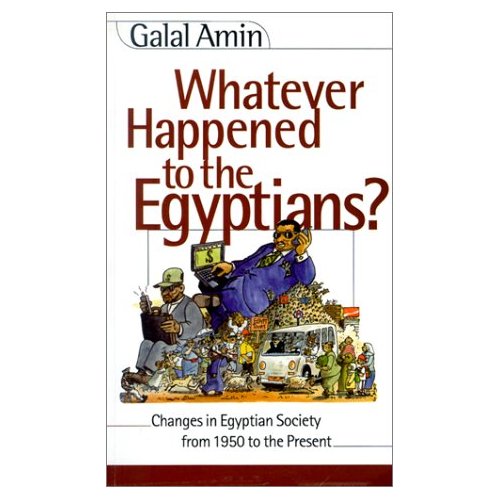
Whatever Happened to the Egyptians?: Changes in Egyptian Society from 1850 to the Present
by Galal Amin


The social history of Egypt in the Middle Ages is well documented by the legendary historian Al Maqrizi who wrote volumes of fascinating history of Egyptians, their rulers, classes and habits. In the last few hundred years starting with Lane writing the social history of Egypt became dominated by the Orientalists who brought their own baggage and prejudices and often supremacist attitudes to the task. Few rare exceptions such as Cairo City Victorious defy the traditional orientalist narratives.

Galal Amin wrote a light hearted, mostly easy to read book about the massive changes that occurred in the Egyptian society since the 1952 military coup aka The Revolution. Amin attributes much of the change in Egypt’s society to a massive expansion of the middle class started under Nasser but accelerated under Sadat with the Open Door policy and the massive demand for Egyptian workers (including unskilled and semiskilled) in the oil rich Arab countries.

Amin used a number of personal but very interesting yard sticks to track the changes in the society. He contrasted his university professor salary with that of the house servant. The gap narrowed significantly after 1952 and much more so after 1972 and started to widen again in recent years. Amin also addressed the role of women in the society and contrasted the changes from his mothers, to his sisters to his daughter. Remarkable change has occurred and Amin’s admittedly non scientific findings correlate closely with those of Leila Ahmed (Women & Gender in Islam). For many women in Egypt the headscarf is a tool of liberation not oppression. Also interesting is Amin’s demonstration of the reduced dependence on the state comparing the days of his father (the famous Egyptian Writer & Professor Ahmad Amin) to the generations of his kids and nephews and nieces.

Overall it is a really nice easy to read book, it is a compilation of different articles and research papers that mostly mesh in nicely to form a reasonably coherent whole

Monday, October 02, 2006

On the Eve of the Anniversary of the Yum Kippur / Ramadan War and the Cold Peace between Egypt & Israel

Normalization would have been a good example to defeat the rejectionist ideology of both sides

The last time the first day of Ramadan and Rosh Hashanah coincided was thirty three years ago; that was the year of the “war to end all wars” according to Anwar el Sadat which started on Yum Kippur or the tenth of Ramadan. I celebrated the first day of Ramadan this year at the house of Jewish friends joining them for their Rosh Hashanah dinner to break my fast. On the way back from dinner I was reflecting on an Al Jazeera TV news program that I saw a while back which showed images of Sadat’s first moments visiting Israel and then the famous pictures of Sadat, Begin and Carter and their big hand shake. The Jazeera program focused on the failure of the normalization between Egypt and Israel and had two guests, the former Israeli ambassador to Cairo and an Egyptian writer. The anchorwoman did not hide her delight at the failure of normalization; the Israeli guest did not seem to have much coherent to say and was not allowed to say much anyhow. The Egyptian guest was full of solidarity with the Palestinians and rejection of the peace process, full of slogans from the Nasser era about Egyptians never forgetting their Arabism. There was really no debate, an Israeli complaining about the Egyptian Government failure to push normalization and an Egyptian complaining about the Egyptian Government for pushing normalization.

The anchorwoman failed to challenge the Israeli ambassador over the early days of the peace between Egyptians and Israelis when ordinary Egyptians welcomed Israelis visiting synagogues in Cairo and Alexandria with applause and when, much to the dismay of most Palestinians and Egyptian Arab nationalists and religious fundamentalists, the overwhelming sentiment in Egypt was pro peace with Israel. It was the Israeli suppression of the two intefadahs, Israel’s continued brutality and injustice against ordinary Palestinians and the rising wave of religious intolerance in the region that eventually led to the shifting in the views of ordinary Egyptians. The anchorwoman also failed to challenge her Egyptian guest over his secular Arabist rationale which is clearly out of step with the Islamic identification that dominates the Egyptian street nowadays. Further she failed to challenge him over the successful normalization in sectors such as Sinai tourism and the number of Egyptian workers in Israel.

There is little doubt that peace between Egypt and Israel is cold and normalization has largely failed. Whether this is a good or a bad thing for the Palestinian cause, which the anchorwoman and her Egyptian guest clearly support, is the question at hand. Watching Al Jazeera, one feels that the default position is that to reject Israel is to be more supportive of the Palestinians.

However, when you have a recipe that has not worked for some 60 years is it perhaps worth re-examining it? Could the venting of hate and anger at Jews, Israelis and their supporters by Arabs and Muslim commentators, who clearly only want the best for the Palestinians, constitute an act of self indulgence and intellectual laziness that can no longer be indulged? Does commitment to the Palestinian cause and solidarity with them prevent their supporters from taking a more analytical approach of the merits of normalization?

Many Arab and Muslim Americans blamed Sharon for the collapse of the prospects for peace over the last 6 years. Could a more successful normalization between Egyptians and Israelis have made Sharon’s case more difficult? As someone who has actively engaged in promoting peace and dialogue in the Middle East for many years I am amazed at how many Israelis actually believe that the Jews of Europe came to mostly empty land in Palestine and the deep rooted hate for Jews and anything Jewish by Arabs and Muslims is what led to the conflict over the last hundred years. Israelis are fed a version of history full of the suffering of the Jews, the massacres of Jews in Hebron in 1929 and in Baghdad in 1941 and again 1969 etc. These events, in the long shadow of the undeniable horrors of the Holocaust, feed a version of history where the wars of 1948 and 1967 are seen as self defense. Even the 1956 Suez war, now fully confessed to by Israel’s co-conspirators as a war of aggression on Egypt, continues to be taught in Israel as a campaign of self defense.

Most Arab and Muslim commentators including many here in the USA appear to have standardized on a language that absolve the Palestinians from blame for electing Hamas. The argument goes something like this: … the Palestinians really wanted the Fateh agenda for peace with Israel but Fateh is so corrupt and incompetent domestically and Hamas has been helping people on the ground. The argument goes on to voice respect for the legitimacy for the Palestinian choice and democracy. Some more sophisticated commentators blame Bush and Sharon for their rejection of Arafat and for their failure to deliver results to his successor Abbas as Israel continued with its violence against the Palestinians and continued to expand settlements and to grab more land from the Palestinians in the West Bank and especially around Jerusalem. While all these points are may indeed be legitimate, here too I would argue that the Palestinians now have made a huge mistake and have chosen their leaders poorly at a crucial point. Democracies make mistakes and Democratic elections that produce legitimate governments can be described legitimately as mistakes. Stronger nations can afford to make mistakes; the Hamas election has proven an expensive mistake for the Palestinian people everywhere.

Should the Arab and Muslim Americans who are strongly committed to supporting the Palestinian people refrain from criticizing the Palestinian choice and refrain from describing Hamas as a terrorist organization? Should we continue to defend the view that an elected Palestinian Government can move back on recognizing Israel and prior “peace” agreements. Should we stay in silence watching the Palestinians inflict self damage with their new elected leaders incompetently presenting the case for Palestine? Should we too take the line of Al Jazeera that normalization is bad business? Should we too buy into describing those who get themselves killed while attempting to kill some random Israeli civilians as martyrs? Should we too here in the US use the Israeli war crimes and their decades long oppression of the Palestinians as a legitimate excuse for everything? Will we be helping the Palestinian cause more by keeping quite and hoping that the new Israeli Government with the party Sharon established at its helm will, out of its own sense of justice or its desperate need to be recognized by the Hamas led Government, actually do something for the Palestinians?

As of today the Palestinians and the Israelis are now ruled by those who reject the possibility of peaceful coexistence and reconciliation in any meaningful form. It is highly unlikely that the real peace prospects for Israelis and Palestinians will move forward in the near future. I would argue that for those who advocate real, just and lasting peace on both sides it is important to speak out now and it is vital to find ways to prove that normalization does work and there is no genetic pre wiring hatred of all things Jewish in the hearts of all Muslims. It is tough to speak out in the middle east except in support of the corrupt Governments, discredited Socialist Arabism or of course the more fashionable narrow Islamic fundamentalism; those of us in the West and particularly in the US should not shy away from speaking out for peace even in such dark times.

Thirty three years ago fasting Muslims and fasting Jews fought one another on a massive scale in the desert of Sinai and on the Golan Heights, for the sake of the memory of the thousands who lost their lives in that war and all the other Arab Israeli wars let’s overcome the hatred and work towards reconciliation; neither side has the option of prevailing by force. Only through dialogue, building trust and understanding the conflicting narratives will there ever be justice and peace in the Middle East.

October 1, 2006

Sunday, September 24, 2006

Tremendous Insight into Egypt Bedouins -- Book Review of Veiled Sentiments by Leila Abu Lughod

Lila Abu Lughod, an Arab American woman, lived among the Awlad Ali tribes of the North West of Egypt for two years. Veiled Sentiments is the book she wrote on the lives and poetry of Awlad Ali. Abu Lughod field work was clearly not carried out from a "superior" stance; she sympathized with her subjects and dealt with them as equal human beings rather than inferior specimen or cultures. Abu Lughod attitude, intelligence, training and tremendous analystical ability helped her in developing great insight and understanding of this fascinating culture.

Abu Lughod analysis of concepts such as "hishma" was truly incisive and shed a great deal of light on the nature of modesty between women and men and amongst men and women. The analysis seems to explain behaviors and norms witnessed elsewhere in Egypt and indeed other parts of the Middle East.

An important thesis of Abu Lughod is that the Awlad Ali people often communicated in very conservative and modest way directly through words; they only said what was proper and fitted the norms. Yet a second mode of communication far more true and expressive was found in their little songs or poems.

Abu Lughod discussed gender relation amongst Awlad Ali at length and the relationship between women and the families of their husbands and the society at large. I really enjoyed this book and would highly recommend it. For an excellent work on veiling and gender issues, I would recommend Leila Ahmed's Women & Gender in Islam.

Egyptians Speak A Language They Don't Respect and Respect Another They Don't Speak --- A Book Review of Sacred Language, Ordinary People by Niloofar Haeri

Niloofar Haeri is an Iranian American; she studied Arabic Language in the USA and went to Egypt to further her studies. On arrival she realized that the language she learnt "modern Arabic" is very different from the language spoken by the Egyptians. The difference was more than just accent or dialect; it was far more fundamental than that. Haeri set out studying the Egyptian "Arabic" language in great detail and studying its role in the society.

Haeri describes contradictions galore in the way the society deals with the language issue and the way the whole language question is suppressed virtually by the entire nation. Egyptians are trapped unable to develop their language because any such development would be a departure from the sacred language of the Quran; a language the Egyptians never spoke and need to learn. Even the Copts, Egypt's Christians see Egyptian Arabic as an inferior language. Some of the amazing findings of Haeri include her analysis of the language of the newspapers which follows the sentence structure of Egyptian Arabic, political speeches and language on the TV. It was interesting to see how presidential speeches in Egyptian Arabic are often "translated" into proper Arabic for official news purposes.

I first heard of this book from a very negative review of the Al Ahram Weekly that was written by an American woman living in Egypt. The negative review was front page of the book review supplement of the Ahram. I was fascinated by it, so on my return to the US I ordered and truly loved it. Outstanding work, very highly recommended!