Saturday, July 27, 2013

The Muslim Brotherhood Democracy of Disenfranchisement

The term gerrymandering was coined out of the undemocratic actions of a governor of my home state; Governor Gerry of Massachusetts. Governor Gerry redrew the electoral district boundaries in a manner that helped his party win the largest possible number of seats. The resulting map of the districts was so absurd, resembling the imaginary salamander and hence the term was invented. Over the years, gerrymandering has continued in many American states, where the party dominating the state legislators could redraw maps to serve their own purposes. Gerrymandering is a fundamentally undemocratic concept; one can look at it as disenfranchisement of those voters, who are being removed from a district where their votes would make a difference to another where their votes are unlikely to affect the outcome of a race. A good example is the carving out of a majority African American area out of a district, where the democratic leaning African Americans are likely to tip the balance of a close race, and adding it to a geographically illogical district that has a large and safe majority of republicans. So instead of the African American votes helping the democratic candidate win, they are wasted. This is dirty politics, no one defends as democratic and some states in the US have made it illegal.

Yet gerrymandering is a relatively benign compared to Ikhwanmandering. This method of disenfranchisement was used in Egypt’s so called parliamentary elections in late 2011 and the early part of 2012. Before we get into what happened in Egypt, let’s just remember what many would know about different election systems; I offer this as not as a political science specialist, but merely as an interested observer.

First Past The Post, Run-offs and Proportional Representation:
Nations have addressed methods of achieving representative democracy in different ways in their constitutions and laws. In the UK and the USA, the First Past The Post is the norm for electing legislators; so whichever candidate gets the most votes in any particular district gets elected; an imperfect system in many ways, but very simple and clear. The French attempted to improve this by creating a system of run-offs or second rounds; whereas the top two vote getters, would have a run off, and whoever gets the most votes is elected. Other nations such as Germany, Italy and Israel adopt a system of Proportional Representation or PR. Different varieties of PR exist, some where voters would vote for a single list, others where voters would rank first, second and third choice off of party lists or candidates. The basic concept of PR is to allow smaller parties to attain representation. We see countries with First Past The Post essentially limited in their choice between Republican and Democrats or Labour and Conservatives whereas with PR, we see far more fragmentation, as in Germany with Social Democrats, Greens, Left, Christian Democrats and Liberals and similar examples of fragmentation in Italy, Israel and other countries.

In Egypt, there is a good argument for PR, where Coptic Christians, who virtually never actually get elected, may be able to have members of parliament, elected by the people and not appointed by a president. Similarly the many different strands, emerging in Egyptian political life could be represented. There is also an argument for the Run-Off system to allow strong parties to emerge. Egypt’s Muslim Brotherhood or Ikhwan worked with then governing Junta SCAF to concoct an amazingly complex system for the parliamentary elections. Their cooperation was possible through, what many assume, an implicit pact designed to marginalize and limit the influence of the original proponents of the January 25 Revolution of 2011. While many legal experts opined that some elements of this system would prove to be unconstitutional, the Ikhwan insisted on this system and were able to intimidate SCAF sufficiently into accepting it. Let’s now review the absurdly complex system that was used in Egypt:

Combo system: The Ikhwanmandering system combines all three systems discussed above together; so we have the PR system and a direct candidate system as well as a run-off. This basically results in enlarging the electoral districts sufficiently to make it harder for those candidates without sufficient organization to compete. The run-offs makes the campaigns more expensive and difficult and afford the better established forces a second chance to bring their national organization power into a district. Sadly, the PR districts while larger than the individual districts, they are not national and therefore still fail to offer representation for minority currents, be it Copts, socialists or other voices. Egypt has no local or regionally elected provincial, regional or locally elected bodies, so it was truly absurd to have PR on a district level, not the country as a whole. 

The Quote System: Another tactics of Ikhwanmandering is to further enlarge the districts by introducing a system of dedicated quota for laborers and peasants. With the definition being loosened enough to allow for wealthy self employed people to run for laborer and peasant seats. So an individual in any big Egyptian City casted votes for an individual candidate, a laborer candidate and a list in his or her own large districts. The quota system served to make it more difficult for emerging political forces to compete against the established Ikhwan or NDP or Mubarak's disbanded party. Oftentimes people simply voted against the NDP in the second round, much as has occurred in the presidential elections. Again, absurdly, while the so called laborer and peasant quota was preserved, the quota for women was dropped.

The Six Week National Ballots: The parliamentary elections of 2011 were carried out over six weeks, with the country divided into three regions, first region had its elections over two days and two weeks later the run offs. The results were announced and then two weeks later, the next region's elections and run offs and results and finally the last region. This clearly was designed to allow for nationally organized forces to be able to support each region in order. While many also argue that it allowed for fraud, for the purpose of discussing Ikhwanmandering, I will not address this topic. The choice of which region goes first needs further research, but it was by no means random. We have seen Ikhwan typically gather their support or protest demonstrations in one or two areas, similarly with elections, it was the use of concentrated national resources to help defeat local candidates who were already spread thin over large districts and financially exhausted with runoffs. 

Shura Council Too: As if six weeks of elections were not enough, SCAF and Ikhwan agreed that there would be a vote for an upper house which would then require six further weeks. The upper house or Shura had virtually no assigned duties and the vote for it was held before any constitution was written and it was unclear if it would actually exist at all under a new constitution. Naturally less than 7% of those eligible to vote bothered to go to the Shura polls.

Many in the west would argue that there are democratic means to overcome gerrymandering; this is indeed true. But let’s not forget that all of these elections were not really for normal legislative bodies, they turned out to be, much to our surprise, the electorate, for the power to form a committeeto write the Constitution. The Supreme Court never had the chance to rule over the legitimacy of this, as the supporters of Ikhwan laid siege to the court for several weeks, before President Morsi declared himself above the Supreme Court and issued a Constitutional Declaration that the Constituent Assembly chosen by the Ikhwanmandered process would be immune from dissolution.  The Ikhwan and their Salafi allies proceeded at breakneck speed to force a Constitution that was mainly focused on the limitations of freedom, limiting religious freedoms to approved religions and limiting equality and citizenship rights to the whim of religious interpretations.

Some Muslim Brotherhood apologists would argue in defense of various aspects of Ikhwanmandering such as the staging of the elections in regions being required to comply with judicial oversight of the elections and no enough judges are available to supervise all the polling stations, yet most judges refused to oversee the referendum over the Ikhwan Constitution and that did not prevent the very same Ikhwan apologists from declaring that defective vote democratic.

The Muslim Brotherhood feared democracy and sought to immunize themselves against it. Their efforts were ultimately about disenfranchisement of their opponents and counter democratic. They had choices and at every juncture they opted disenfranchisement.

AA
July 27, 2013


Saturday, July 06, 2013

Yes it was coup!

In the days before Egyptians went to the polls for the second round run off of the first freely contested presidential ballots, the People’s Assembly or parliament was dissolved and the authority for the legislation of new laws was assumed by the then ruling military Junta, known as SCAF. Some Egyptians felt more comfortable voting for the Muslim Brotherhood candidate Mohamed Morsi, knowing that his authority as head of the executive branch would be limited.

While the parliamentary elections were generally seen to be free, their rules, most definitely were not.  SCAF had imposed a strange and highly unusual set of rules designed to tilt the elections towards the two organized forces in the country; the Islamists and the party of the former president Mubarak, the National Democratic Party. The election rules were designed to make it very expensive for any candidate who is not part of an established large national organization to win. A strange mix of district level proportional representation and quota for laborers resulted in very larger districts, coupled with runoffs for those receiving less than 50% of the vote and a system of staggered ballots over a six week period allowing national organizations to campaign in different regions around the country sequentially. Dissolving such a gerrymandered parliament was indeed a good thing, its composition failed to be even remotely representative of the people of Egypt, as could be seen from the sheer size of the ensuing protests.

The coup process started shortly after the election of President Morsi, when he decreed the return of the dissolved parliament, the courts opposed him and he could not impose his will. Few weeks later, the first part of the coup took place; Morsi kicked SCAF out of the legislative role, a move that was widely welcomed by most Egyptians who believed Morsi and wanted to give him a chance, his approval rating was close to 70%. Few voices warned of the concentration of the executive and legislative powers, but Morsi reassured the nation, by promising that he would, only, make minimal use of his newly acquired legislative powers.

Two additional bodies were yet to be dissolved by the slow courts of Egypt, the so called Shura Council or upper house of the parliament, whose election was made by identical rules to those of the dissolved parliament, but with less than 7% of Egyptians actually bothering to cast a ballot, as it had no defined duties or powers at the time of its election. The second body that was also threatened by the courts was the Constituent Assembly, whose membership was based on that of the dissolved parliament. The likelihood of dissolving these two bodies was very high indeed. President Morsi allowed his supporters to lay siege to the Egyptian Supreme Court and its members were unable to enter the court, let alone hold any sessions for nearly a month. A strange way for a democracy to function!

The siege of the court could not continue indefinitely; fearing the eventual rulings by the Supreme Court, President Morsi moved to perfect his coup, he unilaterally assumed super judicial powers in addition to the legislative powers he had assumed in August.  In late November Morsi declared both the Constituent Assembly and Shura Council immune from dissolution by the courts, and he assigned full legislative powers to the Shura Council, which he was yet to name some additional ninety appointed members and he also declared these decisions to be immune from future legal challenge.

At this point it became clear to many Egyptians that the elected president has engineered and executed an unprecedented coup.  This was Egypt’s big coup, a theft of the January 25, 2011 revolution that was most certainly not Islamist, by the Islamists. It was, at that time, that the seeds of the Egypt’s second revolution were sown by no other than the acts of President Morsi himself.  President Morsi was eventually deposed, following the massive demonstration of June 30, 2013 by millions of Egyptians against him and his Muslim Brotherhood.

Considerable debate has taken place on the legal justification of deposing Morsi, was this a military coup or not? Clear as day, it was military coup, but it was carried out at the will of the vast majority of Egyptians who wanted Morsi out because of his own coup against legitimacy and democracy.

AA

July 6, 2013

Thursday, July 04, 2013

Dear Western Liberals! ..mind your business or read a bit more first!

Lord Cromer was a founding member of the Society Against Women Suffrage and at the same time, he was also advocating that, British rule over Egypt was justified to help liberate its women. A lot of British women at the time, supported British colonial activity because they bought into his argument! Needless to say, under British occupation (1882 – 1922) education in Egypt declined severely and numbers of graduates fell. I am reminded of these contradictions as I read and hear of those western liberals who are decrying the removal of Morsi and speaking out against the will of the Egyptian people forcing the removal of the Fascist regime of Morsi and his gang. So, while they happily push forward the boundaries of freedom in the west, Egypt receives its most restrictive constitution ever with less than 20% of the voters approving it.

Please take sometime to look through the web pages of Ikhwan or Muslim Brotherhood to see their own pride in their history of discrimination  violence, assassinations and oppression. Educate yourselves a bit before you opine on something that you know little about and understand its subtleties even less. 


Finally remember this, normally sedentary Egyptians, who almost all smoke and hate exercise (I'm Egyptian, so I am allowed to stereotype!) do not march several kilometers for no good reason, we are normally as apathetic as they come, but we watched what happened in Iran since 1979 and we watched Europe in 1930's and 1940's; we learnt a thing or two about where fascism leads. So support the will of the people of Egypt or mind your own business and spare us the lectures about how democracy work, you couldn't get more direct democracy than what is happening in Egypt! Just while we are at it, remember what happened to the Prime Minster of Egypt who declared war on NAZI Germany and Fascist Italy? He was assassinated by the Muslim Brotherhood ..bet you never knew that!

AA
July 4 (Independence Day)

Tuesday, July 02, 2013

On Eve of Morsi's departure, what's going on in Egypt!

OK people ..Obama and US Administration want to be seen standing with Morsi to the last minute, the US does not want to be seen as an enemy of Islamists again, you want Caliphate again, have it, but don't bomb New York. Obama knows Egyptian Seculars and liberals are angry, but he knows those don't bomb buildings in America, they just have the same hate/love/envy thing with America as the European left does.

Morsi does not want to resign and admit mistakes, because Muslim Brotherhood makes no mistakes and prefer to have his kids, his followers, all believe that only a small minority of the people of Egypt was against Ikhwan and that the Army and the Americans forced him out, so he can then be a victim and start rebuilding Islamist popularity and credibility again as victims of American Zionism and army etc. etc. 

The army in Egypt just wants to have peaceful life and make money, they don't care too much about US Aid, which is only $1Billion and all of it gets spent on US arms, much more important for them is their budgets in Egypt, the amazing control they have over land, industry, trade, etc. etc. The army does NOT want to run the country, does not want wars or trouble, they just want to get on with free entreprise, make money. 

Islamist masses mainly want to keep their womenfolk under their control and away from any possible dishonor and of course they enjoy seeing Christians and minorities suffer a bit, other than that, they want cars, iPads and sex in that order!

AA
July 2, 2013

Saturday, April 27, 2013

My Boston Marathon


Boston is my hometown, I have spent more of my life there than anywhere else and even though I moved to Europe in 2009, Boston remains the place I feel most at ease at, home. I am not a Boston native, I was born in Cairo where I spent my childhood, when I first moved to the US, I lived in California, which, I loved, but contrary to my own expectations I have become a Bostonian. It is the Boston Red Sox that I follow, WBUR that I listen to on the web and Boston trends I look at on Twitter; home! 

I was on a business trip in Australia, on that saddest of days, the day of the cowardly, cruel attacks on the Boston Marathon. It felt like disaster has struck my immediate family, I was in deep shock and disbelief. The distance from Boston, from my family, along with the massive jet lag and associated sleep deprivation added to my deep sadness, a sense of void in my heart, hollowness in my entire being. I hardly watch TV and rely on Twitter as my primary source of news. The very nature of following such horrible news on social media, naturally, added to my anxiety and tension.

The vast majority of the tweets were from the Boston Globe, other Boston media, CNN, few tweets of eyewitnesses and hundreds of tweets from people in shock and sadness expressing their grief or anger. Some tweets I saw emphasized bigger tragedies in other parts of the world and objected to Boston Marathon bombing dominating their timelines. An Egyptian tweep, mockingly stated that the Egyptians know one kind of running, away from an aggressive dog, or trying to catch a bus. Even though @el_Shazli tweet was of the self-deprecating type, it added to my sadness and actually angered me; how could someone crack a joke at a time like this?

It is a sad fact that many young Egyptians are smokers; a small tiny minority is active in sports of any kind. This generalization applied fully to me up to my early thirties, when I finally quit smoking and attempted to start running. Shortly after that, I moved with my family to Boston, where gradually I started running once or twice a week. I still remember an event that had a profound effect on my life, it was a Monday, Patriots Day, an official holiday in Massachusetts, commemorating early events of the American Revolution. Patriots Day is hardly known or observed outside of Massachusetts; it is celebrated on the third Monday in April and exactly at midday, the Boston Marathon starting gun fires.

I lived in Newton, MA, very close to the route of the Boston Marathon, but it was only after several years of living in the Boston area that I happened to be at home on Patriots Day, what a day it was! The 100th running of the Boston Marathon, a record number of runners, well over 40,000 were allowed to run that year. My kids excitedly took me up the street to the Marathon Route, the road was closed, hundreds of people on both sides, virtually all of our neighbors were there with beach chairs, or just sitting on the curb, lots of people of all ages, a total carnival atmosphere. I looked to the right and left up and down the route, the festival clearly stretches on for miles, all waiting for the runners to arrive.

Suddenly, police sirens, lots of commotion, very loud applause, a couple of police cars pass by and an older man in an open car, standing and waiving cheerfully left and right. I am told this is Johnny Kelley, the Grand Marshall of the Boston Marathon. Just a mile up the road there is a statue I run by of two runners, they are John Kelley, a younger and an older John Kelley. Kelley took part in the Boston Marathon 61 times, completed it 58 times, amazing! I have been running by that statue and now I have seen the man himself in the flesh. Few minutes later, the wheel chairs racers arrive, first the men, then the women … the focus and determination on the faces of these elite athletes close-up is hard to describe. Nearly half an hour later, the main event …the fastest men, fifteen minutes later the fastest women … .and then non stop runners, hundreds and hundreds of runners keep on passing by. The carnival on the street never stops, people offering water, energy drinks and oranges to the runners, cheering, yelling, clapping, lots of high fives. I walked back home for some lunch and some work phone calls, this after all was an ordinary working day for the rest of the country.

Two hours later, I walked up my little street to the Marathon route, still the carnival atmosphere, but with fewer spectators, the runners, were slower obviously, some were older, some were heavier, but plenty of young and athletic looking types too. As time went by there were more tired looking runners, some were clearly suffering from muscle cramps, some were bloodied from falls or the painful bleeding nipples, a common affliction of distance running, that I had not heard of before that day, I also saw plenty with dried salt on their faces, a result of lots of sweating, dehydration and wind. Some of these runners had their names on their shirts, so people would yell out come ‘on Pat or Rick …. others had other messages like running in memory of a father, mother or friend, or for cancer or autism. I stood watching these amazing people, cheering them on; their faces spoke of determination.

I was there for over an hour clapping and encouraging. The sheer determination of these ordinary, these slow runners amazed me, here I was close to Mile 18 of this 26.2 mile route, those runners if they finish, may only get to the finish line after dark, and they were still going and going defying pain and fatigue. I had only been running few miles, but right there and then, on that day, with these slow but determined people passing before me, I decided that I would one day run this Boston Marathon, maybe it would take me two years to do it, but I would run the Boston Marathon!

It took me a while to investigate signing up for the Marathon and after sometime I registered as part of the Kids At Heart team, raising money for the Boston Children’s Hospital. I started training harder, building up the miles. I was running five to six days every week, taking just one day off, I would get up early to run for an hour or so before work and have at least one long run on the weekend. My job required extensive global travel, so I was running everywhere in hotels on treadmills, on the hilly streets of Hong Kong, the crowded waterfront in Bombay, in Hyde Park and along Thames in London and of course along the Boston Marathon route itself when I was home.

Building up to the Marathon the Children Hospital team had organized training runs that were getting longer and longer and I run the New Bedford Half Marathon in March and a 20 Mile race from Maine to Massachusetts in brutally cold conditions. It felt, like I was running all the time, regardless of the cold and snow or even the heat if I was traveling. Three weeks before the date, I eased off on the training and gradually reduced my weekly mileage. I still remember a motivational event organized by Children Hospital where one of the patients spoke. Katie Lynch was in her twenties, but still had the body and voice of a child and hence still a patient of Children’s Hospital dealing with various complicated health issues from her rare genetic disorder. Few years later, this beautiful young woman did something, she never did before … she managed, unassisted, 26 steps, she nearly fell at the end, this was her marathon, years in the making.

Finally, Patriots Day! I woke up early and my, ever supporting, wife drove me the eighteen miles to the west, to Hopkinton, the small town where the Marathon starts. The streets were overflowing with thousands of runners, a short while after I arrived, the roads were closed to traffic, it must feel like some sort of an alien invasion to the residents of this sleepy town. It was a cold day, there was no place to sit, so people kept pacing up and down to keep warm, the lines for the porta-potties were getting ridiculously long, hard to accommodate all these runners hydrating and requiring toilets to the very last moment.

I finally handed my small carry-on bag with my official number stapled to it, the organizers would see to it, that we all receive our bags after the finish line. I went to line up towards the back, I expected that I would finish the marathon in over four and half hours; I wasn’t racing to beat others. We heard the cheers for the start of wheel chairs race and after what felt like forever, at exactly midday the starting gun. Lots of yelling and shouting, screams of excitement and joy, but we didn’t move an inch, after more than ten minutes we started moving slowly and it took me close to fifteen minutes to cross the Starting Line. We were still inching forward and it took another five minutes or so, before enough space opened up and I actually started running ..Finally!

It is hard to describe exactly how I felt then, I was excited for sure, but more I was apprehensive, I had many fears. I was worrying that I would trip up in the crowd, others did; I worried that I would have muscle cramps, that I wouldn’t finish the Marathon after training so hard for it. I had to focus on not starting out too fast, I have to pace myself; the route is mostly downhill for the first fourteen miles and this pounding can be brutal on leg muscles later. I had to keep hydrated even if I didn’t feel thirsty. The crowds on both sides of the road were so thick, cheering us wildly as we went through Hopkinton, then Ashland and Natick … and then we hit scream alley .. what an amazing experience running by Wellesley College whose students for decades have established this amazing tradition of making every single runner feel simply extra special, with their loud cheers and high fives, the young women of Wellesley College organize waves of cheerers so they never get tired.

Nearly five miles later, I made it to Newton and soon, the Newton hills! I run up the first hill, past the fire station and get closer to the spot where I was, not so long ago, standing cheering the runners. I heard my daughter shouting my name, then my son, my wife was there too, so were the neighbors, all cheering me on, my wife shouted that they would meet me near the finish line. I felt stomach cramps, I felt cold, but I went on and headed up heartbreak hill and down past Boston College, with loud music cheering us on.  This is where people normally hit the wall, right around the 20-mile mark, many people just can’t keep going beyond this point. Apart from the cold and my stomach cramps, which were getting worse, I knew that I would be able to finish, so I run on.

I run past Cleveland Circle for a long three miles, strong cold headwind made me feel very chilled, but I kept going, crowds had thinned out, but they were still rooting for us, cheering us on. Finally I passed Fenway and it was not as windy and much more crowded again, then a turn to the right followed by turn to left on to Boylston Street, I run stronger, the Boston Library on my right, I saw my wife standing on the left side of the street, my son is cheering wildly and my daughter shouting Papa! … I run past the finish line four hours and forty some minutes after I started.
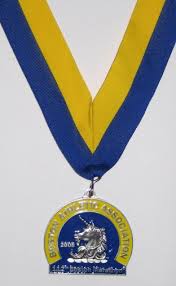
Someone puts a medal around my neck and another young volunteer wraped a blanket around my shoulders and undid my shoelaces to retrieve the official chip that recorded my progress along the entire route. I staggered into a large tent where I retrieved my bag to enjoy the relative warmth and eat bagels and drink more fluids. I could hardly walk… around me hundreds of people, many with tears in their eyes from joy of finishing, from pain, or from both; hundred of marathon winners, each with own stories and reasons for running. The fact that the fastest runners crossed the line some two and half hours before us didn’t mean anything at all to me or to those around me, we were each in our own totally private race surrounded by thousands others with their own private races and we all won!

The Marathon in Boston has a special place, it is the world oldest marathon, it is held on this special holiday, that only we celebrate, it is the beginning, the real beginning of spring after our long harsh winter, it is school holiday week. But perhaps, most importantly, it is the personal stories that lead thousands of people to run, it is the amazing carnival atmosphere all the way from Hopkinton down to the finish line at Copley Square. It is a day of celebration and festivities, celebrating our ability, us ….we ordinary human beings who will our bodies to do the extraordinary …it is a celebration of our determination to defeat addictions or old bad habits, our inner journeys to achieve our hopes and aspirations, positive aspirations for no one runs a marathon for a mean or a negative reason. It is all about us, the runners, our families, neighbors, our friends and the entire community come to celebrate profoundly positive emotions and ideals.

A lot has been written about the brutality and cruelty of the bombings and condemnations of the abhorrent act have appeared everywhere. For many people outside of Boston it is still hard to appreciate what this event means to us. I wanted to write my own account as an Egyptian American, a Bostonian of my first Boston Marathon. I run the Boston Marathon twice more, each time, for my own very personal stories and reasons. The thousands that run on April 15, 2013 each had their own story, their own reasons for embarking on their personal journeys to train for and to run the marathon, so did their loved ones and the more than one million people that lined the streets along the entire route.

Weeks after the tragedy, I think of the amazing young woman, Katie Lynch, whose 26 step marathon required her to train, she did it to motivate us to run. Her little fragile body never stopped her from finishing high school and graduating from college and completing her very own little baby marathon. She did all she could do with her God given body until she finally passed away few years after I first saw her. This is what Boston Marathon about, ordinary people willing their God given bodies to do something very extraordinary and having their entire city will them on and celebrate with them. The bombing of the Boston Marathon is ultimately an assault on our humanity … the best of humanity…..it is a direct attack on the All Mighty God, the creator of these bodies, and it can never, never be of Him or in his Name.

AA
April 27, 2013