Saturday, June 09, 2007

Reflections on Muslim Wake Up byline

This article was the very last article I wrote for MWU, it was never published. The site was taken down around this time. 

Reflections on Muslim Wake Up byline
Remove “prayer is better than sleep”

I love Muslim Wake Up, right from the time it started I felt that there is finally a place for me. To me Muslim Wake Up is a place for those who identify with their Muslim identity and heritage, want to celebrate their faith. I find joy in reading and observing the writings and comments of secular Muslims, progressive Muslims, spiritual or Sufi Muslims, agnostic Muslims, confused Muslims along with those of more traditional orthodox Muslim. For me, Islam is a journey of searching and learning and much of the contemporary main stream Islamic discourse is full of certainty; no search needed.

The “prayer is better than sleep” slogan or byline of MWU has always troubled me. I love the notion of waking up; the Islamic World has been asleep for centuries. After centuries of great contribution by Islamdom in science, philosophy, thought and much achievement towards human advancement, stagnations, reversals, and eventually rot have taken over. Islamic jurisprudence moved from being an example of sophisticated legal code with real examples of beauty and turned into cheap fetwa pronouncements dispensed left and right out of ignorance, for political gains or popular appeasement.  Waking up indeed is needed ..but what do we need to do when we wake up ..think, search, debate, build or pray?

I reflect further on the byline “Al Salat Khier min Al Noom” or “Prayer is better than sleep” and particularly on two words; “better” and “prayer”. In Arabic the word “Khier” encompasses an incredibly huge range of meanings like “good” or “goodness” do but not only. “Khier” has connotations of plenty, of purity, justice, compassion, and much more. Its use in the Quran and in everyday language in my native Egypt is truly beautiful. While I personally lack sufficient linguistic knowledge to make an exact pronouncement I would tend to say that “Khier” definitely encompasses more than good and better which would normally be translated into Arabic as “Gayeed” or “Agwad” (Jaeed or Ajwad”).

As to “Salat” the issue becomes much more complex. Is “Salat” used to mean the specific supplication and rituals required five times daily? Is Salat a more encompassing word including meditation, spiritual connection to God? Are they one and the same? Still the linguistic uncertainly over prayer vs. salat remains, this is mostly because of the common use of prayer in English of requesting or asking for something from God, a concept that is mostly excluded in “Salat” but covered in another Arabic word “Doaa’a”.

So, I continue to reflect on the byline “prayer is better than sleep”. Narrowly interpreted I fear it does not do MWU justice. MUW is about waking up, searching, expressing, it is about shedding centuries of mere unthinking conformance. MWU is certainly not about the passively asking God to make things better. I fully accept that deeper a look into the byline would find alternate meanings that are less inappropriate. Still I would argue that even those are not immediately accessible. Perhaps a byline that illustrate Islamic notions of forgiveness, compassion, universality or equality would be more appropriate. The Quranic commandment of searching for knowledge may fit in more with the sentiment of MWU.


Ayman S. Ashour
June 9, 2007


Sunday, January 14, 2007

Informed and Perceptive View of Iraq - Book Review of Night Draws Near by Anthony Shadid

This is easily the best book I can recommend to anyone on the Iraq war. Anthony Shadid, a third generation Arab American, who speaks fluent Arabic was on the ground before the Iraq war and lived through its phases all the way to the full blown insurgency.

Shadid demonstrates an excellent understanding of the people and the culture, this understanding makes his analysis very valuable indeed. A very important point that Shadid makes is the desire of the people for justice over democracy.

Shadid's understanding of Iraqi society makes his analysis on the insurgency, its roots and its nature very convincing. The analysis of the power structure with the Shiite religious leadership and the diverging loyalties as well as the Iranian versus Arab orientation of the leadership is very well explained. It is remarkable how ill informed much of the media in the US referring to the Mahdi Army, the Sader militia, as Iranian influenced when Shadid explains clearly their roots being as populist & nationalist counter movement to the Iranian dominated Shiite religion leadership.

Through countless daily interactions with Iraqis from all classes, all sects and all political views Shedid offers tremendous insight on the factors that shaped the views of the Iraqis and how these changed over time as the country sunk deeper into a depressing war. Shedid equally well covered the American troops, their perception of their role and of the Iraqis around them.

Can't say enough about this book except I wish it becomes mandatory reading for political and military readers. Shadid's Pulitzer Prize for his reporting of the war is very well deserved!

Monday, October 16, 2006

Saving Sudan & Darfur …..The Muslim Silence and the American Paradox

Sudan has been tearing itself apart for many years now. The war between the SPLA (Sudan’s People Liberation Army) and the Government was relatively well understood by the world outside. The South Sudanese who are predominantly Animist and Christian agitated for independence from an increasingly fundamentalist Islamic state that sought to impose its will on the whole country. As would be expected various outsiders with own agendas and interests weighed in to provide aid and weapons to the SPLA and the Government. Finally after decades of horrible suffering and destruction some sort of peace has finally been reached.

Few days ago an announcement was made about a peace accord reached between the Sudanese Government and the Eastern Sudan rebels; the conflict in the east has received less media attention even though it appears to have intensified prior to Darfur. While the on-going conflict in Darfur has recently been receiving considerable amount of media coverage, there remains a high degree of ignorance of the conflict both in Islamic countries and in the West. Many assume that the conflict is of Arabs against Africans or Muslims against non Muslims; both assumptions are false. This is a conflict of black Africans tribes against other black African tribes and both sides are Muslim. The news media often quotes “Janjaweed, the Arab militias” but there is little Arab about them to support their own claim of Arabness. In fact in the Arab Peninsula they would be referred to as Africans and more often “abeed” or slaves. In the West post 9/11 the terms Arab, Muslim and Terrorist conjure up similar images so Arab Militias carries a lot of emotions and feed the ignorance. Yet the name “Dar Fur”, itself is Arabic for the House of Fur and warring tribes to outsiders are indistinguishable much as the case was in Rwanda with the Hutos and Tutusis.

Another major struggle that is hardly mentioned in the news is what is happening in the Sudan heartland starting with Khartoum itself. Here the brutal fundamentalist regime has for many years been employing harsh suppression measures against its opposition ranging from murder and torture to, at best, exile and house arrest. Some of the victims are also Muslim fundamentalists who oppose with the regime, others include moderates, secularists, leftists etc.

A question that must be asked is why is the relative silence in the Islamic World about the on-going atrocities in the Sudan and in particular Darfur and what can the West and in particular the USA do to stop the carnage in Sudan. The relative silence of Muslim on Muslim massacres continues to be a source of shame and sadness for me. The Darfuri rebel groups receive assistance from pro Western sources. Christian, including Evangelical, and Jewish Charities have allegedly been active in helping the victims in Darfur. Could this be the reason enough for the relative indifference in the Muslim World? The history of the US and particularly French involvement in Northern Darfur dating back to 80’s is murky with the West arming some groups against others to outbid effort by Libya’s Ghadafi to expand his sphere of influence, could this be a factor in the silence of the Muslim World? Is there a tinge of racism? Isn’t the life of a black African Muslim worth the same as that of an Iraqi or a Palestinian? Is Darfur another front in the conflict between America and Islamdom? Are the people of Darfur naive to allow themselves to be used by the West? Do they have it coming? Why is the silence? Why is Darfur not a cause for Muslims and Arabs in the USA and the West? Whose action or inaction is complicit in the killings of hundreds of thousands? Many questions ….few clear answers!

Many observers have been talking of the US loss of moral authority and credibility since the War in Iraq. This is much more the case in the Middle East and the Muslim World, where the US silence on the suffering of the Palestinians and its unwavering support for Israel (right or wrong) makes the US completely disbelieved. The causes that the US advocates are viewed with suspicion and the default position is, virtually always, the anti American position. It is indeed tough for the US to label the death of 400,000 people in Darfur genocide when the numbers of Iraqi war dead are now estimated by some to be even higher …... What can the US do now?

I guess the answer must start with the US Government recognizing the reality that America is no longer viewed as the beacon of freedom and justice it once was, and that the US is viewed with suspicion and fear. It seems that the US, just by merely speaking on behalf of the people of Darfur, contributes to the antipathy and the indifference of many Muslims towards them. So paradoxically as the US tries to intervene to save Muslims from a horrible carnage its efforts boomerang and the Sudan Government is seen as a victim standing up to the US Imperialism and its crusades. The US is in tough position indeed, engage and risk more rejection by Sudan, the Arab League and much of the Muslim World or turn the other way and let genocide unfold into the killing of millions.

As an American Muslim I feel that the US must remain engaged in the effort to save the people of Darfur but it should be done through quite diplomacy and multi lateral organizations such as the UN. The US must refrain from lecturing and from the grandiose rhetoric of condemnations. The US must act and speak in manner that recognizes that it is no longer viewed as a moral authority; a new level of modesty in foreign policy will do more to help the people of Darfur than the big accusatory pronouncements. The US must also accept the limit of its power to shape the agenda in Sudan and elsewhere in the Muslim World. Direct and indirect financial and military aid for different groups by the US will most likely damage the interests of the US in the long run; the US has simply not been successful in this sort of effort for so long. The US may wish to re-direct some of its efforts through Muslim charities from the US and elsewhere and honestly and truly focus exclusively on the human suffering without attempting to gain an edge or advance a foreign policy objective apart from saving the people of Darfur.

Will this be enough to save Darfur and the rest of Sudan? Could this be a start to rebuild the US tattered image in the Muslim World? Could this prompt more voices to speak up against the horrors inflicted by the Sudanese Government?.....…at the very least it would be a start in the right direction!

October 15, 2006

Saturday, October 14, 2006

Not quite modern day Maqrizi but nice effort


Book Review:
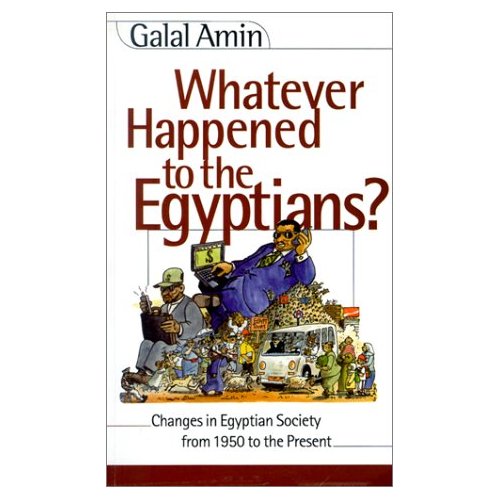
Whatever Happened to the Egyptians?: Changes in Egyptian Society from 1850 to the Present
by Galal Amin


The social history of Egypt in the Middle Ages is well documented by the legendary historian Al Maqrizi who wrote volumes of fascinating history of Egyptians, their rulers, classes and habits. In the last few hundred years starting with Lane writing the social history of Egypt became dominated by the Orientalists who brought their own baggage and prejudices and often supremacist attitudes to the task. Few rare exceptions such as Cairo City Victorious defy the traditional orientalist narratives.

Galal Amin wrote a light hearted, mostly easy to read book about the massive changes that occurred in the Egyptian society since the 1952 military coup aka The Revolution. Amin attributes much of the change in Egypt’s society to a massive expansion of the middle class started under Nasser but accelerated under Sadat with the Open Door policy and the massive demand for Egyptian workers (including unskilled and semiskilled) in the oil rich Arab countries.

Amin used a number of personal but very interesting yard sticks to track the changes in the society. He contrasted his university professor salary with that of the house servant. The gap narrowed significantly after 1952 and much more so after 1972 and started to widen again in recent years. Amin also addressed the role of women in the society and contrasted the changes from his mothers, to his sisters to his daughter. Remarkable change has occurred and Amin’s admittedly non scientific findings correlate closely with those of Leila Ahmed (Women & Gender in Islam). For many women in Egypt the headscarf is a tool of liberation not oppression. Also interesting is Amin’s demonstration of the reduced dependence on the state comparing the days of his father (the famous Egyptian Writer & Professor Ahmad Amin) to the generations of his kids and nephews and nieces.

Overall it is a really nice easy to read book, it is a compilation of different articles and research papers that mostly mesh in nicely to form a reasonably coherent whole

Monday, October 02, 2006

On the Eve of the Anniversary of the Yum Kippur / Ramadan War and the Cold Peace between Egypt & Israel

Normalization would have been a good example to defeat the rejectionist ideology of both sides

The last time the first day of Ramadan and Rosh Hashanah coincided was thirty three years ago; that was the year of the “war to end all wars” according to Anwar el Sadat which started on Yum Kippur or the tenth of Ramadan. I celebrated the first day of Ramadan this year at the house of Jewish friends joining them for their Rosh Hashanah dinner to break my fast. On the way back from dinner I was reflecting on an Al Jazeera TV news program that I saw a while back which showed images of Sadat’s first moments visiting Israel and then the famous pictures of Sadat, Begin and Carter and their big hand shake. The Jazeera program focused on the failure of the normalization between Egypt and Israel and had two guests, the former Israeli ambassador to Cairo and an Egyptian writer. The anchorwoman did not hide her delight at the failure of normalization; the Israeli guest did not seem to have much coherent to say and was not allowed to say much anyhow. The Egyptian guest was full of solidarity with the Palestinians and rejection of the peace process, full of slogans from the Nasser era about Egyptians never forgetting their Arabism. There was really no debate, an Israeli complaining about the Egyptian Government failure to push normalization and an Egyptian complaining about the Egyptian Government for pushing normalization.

The anchorwoman failed to challenge the Israeli ambassador over the early days of the peace between Egyptians and Israelis when ordinary Egyptians welcomed Israelis visiting synagogues in Cairo and Alexandria with applause and when, much to the dismay of most Palestinians and Egyptian Arab nationalists and religious fundamentalists, the overwhelming sentiment in Egypt was pro peace with Israel. It was the Israeli suppression of the two intefadahs, Israel’s continued brutality and injustice against ordinary Palestinians and the rising wave of religious intolerance in the region that eventually led to the shifting in the views of ordinary Egyptians. The anchorwoman also failed to challenge her Egyptian guest over his secular Arabist rationale which is clearly out of step with the Islamic identification that dominates the Egyptian street nowadays. Further she failed to challenge him over the successful normalization in sectors such as Sinai tourism and the number of Egyptian workers in Israel.

There is little doubt that peace between Egypt and Israel is cold and normalization has largely failed. Whether this is a good or a bad thing for the Palestinian cause, which the anchorwoman and her Egyptian guest clearly support, is the question at hand. Watching Al Jazeera, one feels that the default position is that to reject Israel is to be more supportive of the Palestinians.

However, when you have a recipe that has not worked for some 60 years is it perhaps worth re-examining it? Could the venting of hate and anger at Jews, Israelis and their supporters by Arabs and Muslim commentators, who clearly only want the best for the Palestinians, constitute an act of self indulgence and intellectual laziness that can no longer be indulged? Does commitment to the Palestinian cause and solidarity with them prevent their supporters from taking a more analytical approach of the merits of normalization?

Many Arab and Muslim Americans blamed Sharon for the collapse of the prospects for peace over the last 6 years. Could a more successful normalization between Egyptians and Israelis have made Sharon’s case more difficult? As someone who has actively engaged in promoting peace and dialogue in the Middle East for many years I am amazed at how many Israelis actually believe that the Jews of Europe came to mostly empty land in Palestine and the deep rooted hate for Jews and anything Jewish by Arabs and Muslims is what led to the conflict over the last hundred years. Israelis are fed a version of history full of the suffering of the Jews, the massacres of Jews in Hebron in 1929 and in Baghdad in 1941 and again 1969 etc. These events, in the long shadow of the undeniable horrors of the Holocaust, feed a version of history where the wars of 1948 and 1967 are seen as self defense. Even the 1956 Suez war, now fully confessed to by Israel’s co-conspirators as a war of aggression on Egypt, continues to be taught in Israel as a campaign of self defense.

Most Arab and Muslim commentators including many here in the USA appear to have standardized on a language that absolve the Palestinians from blame for electing Hamas. The argument goes something like this: … the Palestinians really wanted the Fateh agenda for peace with Israel but Fateh is so corrupt and incompetent domestically and Hamas has been helping people on the ground. The argument goes on to voice respect for the legitimacy for the Palestinian choice and democracy. Some more sophisticated commentators blame Bush and Sharon for their rejection of Arafat and for their failure to deliver results to his successor Abbas as Israel continued with its violence against the Palestinians and continued to expand settlements and to grab more land from the Palestinians in the West Bank and especially around Jerusalem. While all these points are may indeed be legitimate, here too I would argue that the Palestinians now have made a huge mistake and have chosen their leaders poorly at a crucial point. Democracies make mistakes and Democratic elections that produce legitimate governments can be described legitimately as mistakes. Stronger nations can afford to make mistakes; the Hamas election has proven an expensive mistake for the Palestinian people everywhere.

Should the Arab and Muslim Americans who are strongly committed to supporting the Palestinian people refrain from criticizing the Palestinian choice and refrain from describing Hamas as a terrorist organization? Should we continue to defend the view that an elected Palestinian Government can move back on recognizing Israel and prior “peace” agreements. Should we stay in silence watching the Palestinians inflict self damage with their new elected leaders incompetently presenting the case for Palestine? Should we too take the line of Al Jazeera that normalization is bad business? Should we too buy into describing those who get themselves killed while attempting to kill some random Israeli civilians as martyrs? Should we too here in the US use the Israeli war crimes and their decades long oppression of the Palestinians as a legitimate excuse for everything? Will we be helping the Palestinian cause more by keeping quite and hoping that the new Israeli Government with the party Sharon established at its helm will, out of its own sense of justice or its desperate need to be recognized by the Hamas led Government, actually do something for the Palestinians?

As of today the Palestinians and the Israelis are now ruled by those who reject the possibility of peaceful coexistence and reconciliation in any meaningful form. It is highly unlikely that the real peace prospects for Israelis and Palestinians will move forward in the near future. I would argue that for those who advocate real, just and lasting peace on both sides it is important to speak out now and it is vital to find ways to prove that normalization does work and there is no genetic pre wiring hatred of all things Jewish in the hearts of all Muslims. It is tough to speak out in the middle east except in support of the corrupt Governments, discredited Socialist Arabism or of course the more fashionable narrow Islamic fundamentalism; those of us in the West and particularly in the US should not shy away from speaking out for peace even in such dark times.

Thirty three years ago fasting Muslims and fasting Jews fought one another on a massive scale in the desert of Sinai and on the Golan Heights, for the sake of the memory of the thousands who lost their lives in that war and all the other Arab Israeli wars let’s overcome the hatred and work towards reconciliation; neither side has the option of prevailing by force. Only through dialogue, building trust and understanding the conflicting narratives will there ever be justice and peace in the Middle East.

October 1, 2006

Sunday, September 24, 2006

Tremendous Insight into Egypt Bedouins -- Book Review of Veiled Sentiments by Leila Abu Lughod

Lila Abu Lughod, an Arab American woman, lived among the Awlad Ali tribes of the North West of Egypt for two years. Veiled Sentiments is the book she wrote on the lives and poetry of Awlad Ali. Abu Lughod field work was clearly not carried out from a "superior" stance; she sympathized with her subjects and dealt with them as equal human beings rather than inferior specimen or cultures. Abu Lughod attitude, intelligence, training and tremendous analystical ability helped her in developing great insight and understanding of this fascinating culture.

Abu Lughod analysis of concepts such as "hishma" was truly incisive and shed a great deal of light on the nature of modesty between women and men and amongst men and women. The analysis seems to explain behaviors and norms witnessed elsewhere in Egypt and indeed other parts of the Middle East.

An important thesis of Abu Lughod is that the Awlad Ali people often communicated in very conservative and modest way directly through words; they only said what was proper and fitted the norms. Yet a second mode of communication far more true and expressive was found in their little songs or poems.

Abu Lughod discussed gender relation amongst Awlad Ali at length and the relationship between women and the families of their husbands and the society at large. I really enjoyed this book and would highly recommend it. For an excellent work on veiling and gender issues, I would recommend Leila Ahmed's Women & Gender in Islam.

Egyptians Speak A Language They Don't Respect and Respect Another They Don't Speak --- A Book Review of Sacred Language, Ordinary People by Niloofar Haeri

Niloofar Haeri is an Iranian American; she studied Arabic Language in the USA and went to Egypt to further her studies. On arrival she realized that the language she learnt "modern Arabic" is very different from the language spoken by the Egyptians. The difference was more than just accent or dialect; it was far more fundamental than that. Haeri set out studying the Egyptian "Arabic" language in great detail and studying its role in the society.

Haeri describes contradictions galore in the way the society deals with the language issue and the way the whole language question is suppressed virtually by the entire nation. Egyptians are trapped unable to develop their language because any such development would be a departure from the sacred language of the Quran; a language the Egyptians never spoke and need to learn. Even the Copts, Egypt's Christians see Egyptian Arabic as an inferior language. Some of the amazing findings of Haeri include her analysis of the language of the newspapers which follows the sentence structure of Egyptian Arabic, political speeches and language on the TV. It was interesting to see how presidential speeches in Egyptian Arabic are often "translated" into proper Arabic for official news purposes.

I first heard of this book from a very negative review of the Al Ahram Weekly that was written by an American woman living in Egypt. The negative review was front page of the book review supplement of the Ahram. I was fascinated by it, so on my return to the US I ordered and truly loved it. Outstanding work, very highly recommended!

Saturday, August 05, 2006

Irreconcilable Narratives from 1967 to 2006


I was only seven years old then, but I still remember the frightening sound of the Israeli war planes up in the sky and the sound of the distant bombing and that of the Egyptian anti aircraft guns. We lived on the edge of Cairo adjacent to some nondescript military installation with whom we had a dispute over a small piece of property that was part of our house and would eventually become our one car garage. This was back in June 1967, just off school and looking forward to the summer and maybe a holiday on the Mediterranean beaches in Alexandria. I feel somewhat a fraud because these days have had such an impact on my life; Cairo was far away from the real center of the war and while hundreds of thousands from each of the three big cities of the Suez Canal had to flee their homes I am not really aware of any civilian destruction in Cairo itself. Yet those days of fear, panic and of nightly shouts of “tafou el nour” telling us to turn the lights off have left their mark on me.

Ten years later, while living in England, I would seek out Israelis to know how it felt on their side, what were they thinking, I would visit a synagogue in Manchester and attend meeting with Jewish Groups. Many years later I am still active in dialogue in person and on the internet advocating reconciliation and peace in the Middle East. I have now come to accept that there will NEVER be one set of facts surrounding the 1967 war; was it a war of self defense or a war of aggression? Why were the Egyptian POW’s brutalized by the Israelis? Why did Israel immediately (and later too) annex territory and just a few years later started a colonizing settlement policy? Was Egypt’s Nasser really a threat to Israel or just a loud mouth? How come the Egyptian army was not even on an “alert state”? But why did Nasser threaten to blockade the Red Sea? How come Israeli intelligence knew so much about Egypt that the Arabic Service of Radio Israel broadcast helpful hints to the students taking General Secondary School Certificate just few days before the start of the war yet thought that Egypt was really a threat? Can Israel be blamed to taking Nasser’s bravado seriously?

I now accept that there is no real factual answer to these questions. Each side has its narrative, its own proprietary set of facts that can be substantiated with loads of logic and evidence, yet diametrically opposing and irreconcilable. This was in the dark ages before the internet, blogs, 24 hours news station like CNN, BBC and Al Jazeera. Somehow I thought such contradictions in the basic facts ..what really happened could never be repeated in the Middle East. I was wrong! I have just returned to Boston from a business trip to Europe that included a four day side trip to Egypt. So, I was in the US for the start of the 2006 hostilities watching CNN and listening to NPR, moved on to the CNN International & BBC and then on to Al Jazeera, Al Manar (Hezbollah’s very own TV station) and Egyptian Government and opposition newspapers and talking to friends, relatives and strangers about the events.

Where best to start, simply the very basic facts are disputed and hence the positions that people take are radically different. While it is hard to generalize I will attempt to portray the basic facts as seen in my predominantly pro Israel US community & US media, a glimpse of Europe and lastly in Egypt. The Israeli Palestinian conflict is much more complex and so I will attempt to focus on the Lebanese Israeli war except of course the Palestinian dimension does play a very important role and supporting evidence of the various conflicting facts. Much of what follow will essentially be generalizations that aimed at capturing the main themes.

In the US, the situation is very clear cut. Hezbollah is already listed as a terrorist organization; the fact that it is a member of a Government we recognize is explained away as part of our support for the Lebanese Cedar Revolution aiming at ridding Lebanon’s of Syria’s occupation and national reconciliation. Israel unilaterally withdrew from Gaza and from Lebanon; Palestinian terrorists kept on firing rockets on Israel and actually carried a raid on Israel taking an Israeli soldier hostage. Israel attacked Gaza in self defense to silence the rocket attacks and to free its hostage; innocent Palestinians civilians were killed while Israel pursued armed terrorists; Israel had no choice but to attack those who attack her and these terrorists hide in civilian areas so there is bound to be civilian causalities; the onus is on the Palestinian terrorists, the Palestinian Authority which is clearly complicit in the terrorism and for the civilians who harbor them.

Hezbollah invaded the internationally recognized and undisputed border of Israel and killed Israeli soldiers and took two of them hostage. Hezbollah acts were essentially in support of the Palestinian terrorist and part of their hate of Israel, which they refuse to recognize, has a right to exist. The timing may have been motivated by Iran and its nuclear issues. The US must support Israel as a very active partner in the War on Terror or WoT. In this war, like Iraq and Afghanistan civilians will die but it is ultimately for their own good to liberate them from oppressive terrorists. This sort of logic is very prevalent across the entire political spectrum in the US not just in the strongly pro Israel community where I live. The limited voices of dissent mainly focus on the scale of destruction of Lebanon and the evacuation of the US citizens from Lebanon. Very few faint voices go beyond that and the vast majority of people see Israel very much doing the right and responsible thing.

European media including CNN International which is in competition with BBC World rather than Fox News and most people I talked to believe Israel’s version of the events on Lebanon but not Gaza. A relatively small minority buys the current hostility as part of the WoT, indeed most don’t see Iraq’s war as part of WoT either. There is a fair amount of sympathy for the Palestinians but not necessarily Hamas and Hezbollah is negatively viewed as a repressive terrorist organization that provoked Israel and was responsible for so much kidnapping, death and destruction for many years. The view of Israel is less glowing and there is tremendous sympathy with the Lebanese people and anger at both Hezbollah and Israel for killing civilians.

The Egyptian narrative is entirely different. The vast majority of the people I talked to, in fact everyone I talked to, believe that Hezbollah never ventured into internationally recognized Israeli territory but into an area that Israel has occupied since 1982. Israel has refused to hand this territory back to Lebanon claiming it was never part of Lebanon and was indeed part of Syria. Hezbollah attacked Israeli occupation forces and took two Israeli soldiers prisoners not hostage. Hezbollah is on record that while it does not recognize Israel it is a nationalist Lebanese movement and it leaves the struggle of Palestine to the Palestinians; its aims are purely liberating all Lebanese territory and freeing Lebanese hostages held in Israeli prisons. Hezbollah only fired rockets on Israeli towns after Israel attacked Beirut and its original operation was against Israeli military not civilians. I had not heard this version of events before I arrived in Egypt. The headline of the opposition newspaper “El Wafed” cried “Revenge …Revenge ..Revenge” after the Qana massacre which was shown in graphic details on al Jazeera and Al Manar TV and also on CNNI. El Wafed, the party that was re-established in the 70’s with a strong capitalist roots and alignment to the west has had to go fully populist and blatantly anti Semitic (contrary to its 1919 roots) to criticize the Government as incompetent and has called for freezing or canceling Egypt’s peace treaty with Israel, probably knowing fully well that this would not be done. The Muslim Brotherhood was critical of Saudi Islamic rulings blaming Hezbollah and I have heard that some Wahabi influenced Imams were roughed up by the worshippers after the Friday prayers for taking anti Hezbollah positions. The general feeling is that Israel’s attack was premeditated and was waiting for an excuse; Israel military incursion into the area it occupied from Lebanon since 82 was the original provocation. Iran is no threat to Israel and it needs nuclear weapons to protect itself from the US & Israel.

In the lazy days of summer on the Egyptian Mediterranean coast people were completely occupied with the events and very sad of the destruction of Lebanon and the cruelty of Israel. Opposition parties are racing to attack the Government over trade with Israel and various trade unions and professional syndicates are kicking out members who have been engaged in “normalization” with Israel. The Opposition papers are as one sided and populist as Fox News; it is all Bill O’Riley without the ugly purple ties and as anti Semitic as he is anti Muslim & Arab if not a tad more. While talking heads on CNN & Fox talk with authority over Sunni and Shiite splits, they are clearly ignorant of how this sectarian issue plays such a minor role in countries such as Egypt which has virtually no Shiites but its majority Sunni Muslims has a very strong spiritual alignment with Shiite Islam not seen in countries such as Iraq.

I have always been very interested to learn more about the lives of the 1948 Palestinians who remained in Israel, those often referred to as Israeli Arabs who make up nearly one fifth of the population of Israel. When I heard that one of Hezbollah rockets landed in Nazareth and killed 2 children and saw on CNN the crowded streets I guessed it must have been the Palestinian part of Nazareth, later I heard on the BBC that it was indeed the case. I saw an interview with the distraught father on al Jazeera just once. I asked many of the people in Egypt I met if they knew that Palestinian kids were being killed by Hezbollah rockets, many people had no idea and were shocked. When I mentioned that Haifa shelters had Palestinian and Jewish Israelis in them they were surprised and somehow uncertain what to think. With so many CNN and other American reporters in the North of Israel I would have expected much more reporting on the Israeli Arabs, their living conditions, adequacy of shelters and the like but that too was lacking. The relative silence on the Israeli Palestinians or Arabs was virtually the only thing in common. Their existence is annoying inconvenience to both sides; their lack of adequate participation in Israelis society as an embarrassment to those wanting to present Israel as a liberal egalitarian society and whatever participation they do have in the Israeli society is too much for those who believe Israel is total evil that can never be reconciled with. At least there is some common ground but not much room for hope from this!


AA
Aug 5, 2006

Friday, July 28, 2006

Faith Restored: Reclaiming Islamic Jurisprudence - Review of Speaking in God's Name -- by Khaled Abu el Fadel

This is a phenomenal work, it presents the intersection of knowledge from three different dimensions that rarely come together, especially when addressing Islam. Khaled Abu el Fadel masterpiece, Speaking in the Name of God, builds on his deep knowledge of traditional Islamic jurisprudence, western thought on divergent topics such as philosophy, anthropology and linguistics and finally scientific research methods.

In this book Abu el Fadel sets about discussing basic fundamentals of the basic text of the Quran, he argues persuasively that the actual text of the Quran is authoritative whereas its interpretations are not necessarily so. Abu el Fadel proceeds to cover the concept of "agency" and the responsibilities that must be assumed by anyone who claiming to interpret Islam and produce responsa or "fetwa". A tour de force of traditional Islamic Jurisprudence is presented setting the rules of how a fetwa can be reached, rules of evidence, weighing of multiple or contradictory indications, method of reasoning and ultimately presentation of results or fetwa.

Sharia Law as presented by Abu el Fadel is a far more nuanced and complex legal code. It is very different from how it is commonly interpreted today in both the West and the Muslim World. A number of examples of Law from Saudi Arabia are presented in particular in relation to the restrictions imposed on women. Abu el Fadel presents the official Saudi Islamic rulings and sets about dissecting them in great detail and examining them under the microscope of traditional Islamic jurisprudence with its restrain and extraodinary care not to usurp the intent of God and force one's own will on Islam.

Abu el Fadel goes to the root of some of the "Hadith", Prophet Mohammad sayings, that have been used over the years to limit the role of women in Islam. Abu el Fadel presents, through detailed analysis of history and Islamic Jurisprudence, different versions of a specific Hadith that mandates duty of obedience on women towards their husbands. Abu el Fadel argues persuasively, with evidence that he established, that this commonly accepted Hadith is indeed fake. Abu el Fadel also presents the motives that could lay behind the number of fake Hadith's specially in relation to the split between Sunni and Shiite Islam. Consistent with his basic thesis Abu el Fadel, presentations and conclusions are reached through rigorous examination of all evidence, weighing of the evidence, balancing of the various factors in accordance with the established rules of Islamic Jurisprudence.

Khaled Abu el Fadel's modesty and "scientific humility" comes across in his restraint in drawing conclusions and in his constant attempts at presenting counter arguments to his own conclusions.  Abu el Fadel's  uses a tentative, non confrontational approach towards building up his conclusions. Abu el Fadel displays a tremendous example of what non authoritarian behavior is all about through his own care not to fall into the common trap that has become the standard approach to Islam today.

Tuesday, February 07, 2006

Cartoons, Ships, Danes, Italians, Egyptians & Saudis


I woke up yesterday to morning papers and internet news showing pictures of angry people on the streets of Cairo. A boatful of poor Egyptian laborers returning from Saudi Arabia to the South of Egypt went down in the Red Sea. A fire erupted on the boat some 90 minutes after it left the Saudi Port and for some unknown reason the boat did not return to Saudi and it kept going farther out to sea. Some hours later, the reports are still conflicting but most say 2 hours, the boat took in water and 15 minutes after that went down with some 1400 people in the dark shark infested waters of the Red Sea. Rescue operations commenced some 8 to 13 hours later, again conflicting reports, and less than 400 people were saved and taken to hospitals in Egypt.

Poor Egyptian laborers from the South of Egypt often go to work in the oil rich countries; they often work in the construction industry and many at relatively low paying jobs that do not afford them luxury of annual trips home. Thus the workers stay away from home for several years and finally return with their savings carrying gifts to their families. I expect some would use bank facilities to wire their savings home but the vast majority would have carried all of their earthly possessions back with them on board. So down went some 1000 people and the livelihood and hopes of some 1400 poor families; all lost to the bottom of the Red Sea. The War On The Poor continues to claims its victims from New Orleans and the Gulf of Mexico Coast to Pakistani Kashmir and trains and now to the Red Sea.

So far I have not heard of people taken to hospitals in Saudi or any Saudi participation in the rescue, perhaps the poor drowning Egyptians lacked the necessary re-entry permits. Naturally I assumed that the angry demonstrations on the streets of Cairo were against the Saudi and the Egyptian authorities. I was mistaken the angry mob was demonstrating against ..the USA for Iraq …no no ..Israel for Palestine ..no no the angry mob on the streets of Cairo were demonstrating against Denmark and the now infamous anti Muslim offensive cartoons. Egypt was not that bad, in Syria where self expression without Government approval is as rare as the balanced coverage on Fox News the Danish and Norwegians Embassies were torched …not a word about the 1000 or so Egyptians that downed!

The Danish cartoons were doubtless offensive. An attempt to defy self censorship and to reassert the freedom of expression is somewhat more acceptable when lampooning one’s own culture or heritage but attacking others especially at a time of rising incidents of racism and Islamophopia is unacceptable behavior. While the Prime Minster of Denmark publicly expressed regret over the publication of the Cartoons I am unaware that neither Italian Prime Minster Berlusconi nor any of his predecessors have ever expressed regret over the much more offensive portrayal of the Prophet Mohammad by Dante.

If the Danes want to continue to portray themselves as forward looking liberal egalitarian society yet support a newspaper (by buying it and advertising in it) that promotes racism I say let them. Islam is not insulted by such bigotry anymore than it was by Dante centuries ago. Islam and Muslims however are insulted far worse when we allow the extremists to steal the banner of Islam and commit heinous crimes under its name and remain silent. Danish cartoons are a bigger danger to Denmark and to what and how the Danes claim to see as their values. Some have argued that it is up to Muslims of Demark to deal with this problem, I would argue that it is up to Non Muslims of Denmark to boycott the offensive paper and those who advertise in it. I would argue that this needs to be done through discussions and dialogue and not even a boycott of Danish products let alone violent demonstration that reinforce the negative stereotypes that we object to in the cartoons.

I wish that the sense of activism and outrage on the streets of Cairo and Damascus and many other Muslim countries is redirected towards more fundamental Islamic issues. “Mercy” and “Compassion” and their linguistic derivatives are by far the most repeated words of the Quran. Where is the mercy and compassion towards the passengers of El Salaam 98? Where is accountability or justice? Isn’t the seeking of justice fundamental to the Islamic belief or does that only apply when the perpetrators of the injustice are non Muslims??


AA
February 5, 2006

Friday, January 28, 2005

Remembering Auschwitz


Comparing Palestinians' Unique Suffering with Holocaust Leads Nowhere!

The horrible genocide committed against the Jews by Nazi Germany, with the collaboration of other Europeans, during WWII was one of the worst events of the 20th century. To be sure, the last century had many other horrible episodes of genocide: the Gypsies, the Armenians, the Hmong, the Tutsis, and others. Horrors perpetrated by the likes of Stalin, Pol Pot, and the Chinese Cultural Revolution make the 20th century a very bloody one indeed.

Meanwhile, some Muslims and other sympathizers of the Palestinian cause have taken to comparing the ongoing suffering of Palestinians to the Holocaust.

The mass killing of millions of people from the very old to newborns with industrial efficiency for the sole purpose of exterminating a whole race is beyond words in its cruelty, criminality, abhorrence and indeed in its uniqueness. The road towards peace and reconciliation does not go through denial of the suffering of Jews; understanding the narratives of the "other" is a prerequisite for any real reconciliation. Those Muslims and other supporters of the Palestinians who deny or minimize the Holocaust do major disservice to the Palestinian cause and cause more Jews and Israelis to turn a blind eye to the suffering of the Palestinians.

Indeed, Palestinian suffering is unique as well and should not be compared to anything else. The courage of ordinary Palestinians living under a brutal occupation, the non-violent Palestinians who suffer in the refugee camps generation after generation, the Palestinian families living in New Jersey or Michigan, leading their new lives but remembering ..still remembering, writing, demonstrating is unique. The ability of Palestine to remain a viable dream in the hearts of millions despite its very powerful foes is unique! For over a hundred years now, Zionism has enjoyed the backing of the world’s most powerful powers; it has captured the imagination of the world’s so-called liberals and progressives then moved on to capture the imagination and support of its conservatives and evangelicals. Throughout this time, the ordinary people of Palestine have continued to struggle, and the word Palestine is now again an accepted part of the vocabulary.

In Tibet, the suffering, destruction and colonization were brutal, yet the world's liberals, intellectuals and celebrities spoke out against China and raced for a piece of the Dali Lama. The suffering of the Tibetans is recognized by the world. In certain respects, the eradication of their culture has been more complete than that of the Palestinians. In much of the world, Tibetans are seen as peaceful and spiritual, while Palestinians are portrayed as militant double-talking terrorists.. Whose suffering is greater? Which wound is more painful? When is a killing by one brutal occupier less painful than the killing by another brutal occupier? Comparisons and more senseless comparisons lead nowhere.

For Palestinians, where else are there such overwhelming odds against a people, people who have sadly not been blessed with wise leaders but who have an abundance of courage and perseverance? The suffering of Palestinians should not be compared to the suffering of others, and in the process be belittled by those who support them.

Let's not compare, all suffering is unique, and the suffering of the Palestinian people is no different. Let us today join the Germans, the Russians, the French and pray for the souls of the countless Jews who perished in the horrible ovens of Auschwitz—let's honor and respect their memory, and please, let us not compare!


AA
January 28, 2005

Monday, November 01, 2004

The Lord Cromer and President Bush Connection: Touting Freedom Abroad While Suppressing Them at Home


At the turn of the Twentieth Century when Great Britain was the undisputed global power, with vast colonies stretching across the whole world, Britain saw itself as a force for good. British colonialism was relatively unabashed about the economic benefits of its empire and often justified its ruling of other people as a way of protecting its economic interests from other colonial powers, specially France. Britain feared for its trade routes into India and on these grounds justified its occupation of Egypt, an occupation that lasted from 1882 to 1954. Yet Great Britain also viewed its colonial activities as civilizing missions.

Lord Cromer was perhaps the most famed British colonial ruler of both Egypt and India. While Egypt was nominally an independent country loosely affiliated with the Ottoman Empire, India was an outright colony of Great Britain. Lord Cromer's role in each country was similar—he was the central authority, the supreme leader.

Lord Cromer viewed Britain's control of its various possessions with an almost missionary zeal: yes trade was important and the supply of raw material for British factories had to be secured, but it was also his duty to "civilize" the natives, lift them from their centuries of social decay and laziness, and liberate their women.

Cromer generally looked down on his Egyptian subjects; he still viewed even those who were educated in England and France as inferior. Cromer was very articulate in his assessment of the failures of the natives and their culture and he often justified harsh tactics against Egyptians as the only means to be understood by a backward culture, a "cruel to be kind" justification. Cromer was very critical of the subservient status of women in Egypt and often invoked examples of abuse of women in Egypt to illustrate how Egypt needed Britain's firm guiding hand. Polygamy and veiling, along with other examples of women's subjugation, were cited by Cromer as evidence of the backwardness of Egyptian society.

A hundred years later, the West is, once again, engaged in the Middle East. Great Britain plays a supporting role in other occupations, now starring the USA. Unlike the primarily commerce driven colonial occupation of the previous centuries, the current American interest in the Middle East is driven more by claims of self defense and the need for social reform. Yet, many opponents of America's policy characterize its interest in the Middle East as primarily economic, focused on oil wealth. Indeed some supporters of America's role in the Middle East use security of oil supplies as a justification for intervention. While debate rages over the pros and cons of America's policy and the presence of American troops in Iraq and, to a lesser extent, Afghanistan, there is considerable backing across the political spectrum for the American efforts to liberate women from the shackles imposed on them by local customs and laws.

The interim governments in Afghanistan and Iraq included women; American media was full of stories of the near total subjugation of women under the Taliban rule in Afghanistan. While in practice women's rights may have actually eroded in Iraq after the US invasion, most Americans believe that the American presence will result in an improved life for Iraqi women. This view is questionable, given the rise to power of Iraqi theologians as the ultimate guarantors of Iraq's stability following the eventual transfer of true sovereignty back to an Iraqi Government.

Lord Cromer justified British tactics in Egypt on the ground of backward culture that oppressed half of the society, a culture that needed modernization. However, following the British occupation, women's education in Egypt suffered and enrollment fell under the guidance of the West's liberating influence. Yet many liberal minded British people, unaware of the facts, supported Cromer and the British occupation because of the "good" that Britain could do for backward societies. A hundred years later, Americans searching for some positive aspects to the liberation and occupation of Iraq may disagree with the American intervention, but, as with Afghanistan, look for some "good" to come out of it for Iraqi women.

While Lord Cromer talked the language of social reform and justice in Egypt, his record at home was poor. He was a founding member of a leading British organization that opposed women's suffrage in Britain. Cromer worked on gaining the support of women's groups in Great Britain for the British colonial expedition in Egypt using their language of social justice, yet fought against the cause of social justice at home.

George Bush has recently launched the Greater Middle East Initiative, an initiative that focuses on social and economic reform in the Middle East. Many who oppose Bush's policies rally to his side when he talks of social justice in the Middle East, of the right of little girls to go to school and of the rights of women. While the vote for women in America has been achieved long ago, there remain parallels from a hundred years ago. President Bush's sense of social justice has propelled him to call for an amendment to the US Constitution to restrict gay equality and is determined to curb women's rights in other areas such as the choice to end pregnancy. Bush's effort to roll back civil liberties through the Patriot Act have been widely condemned by virtually all civil rights institutions, American and foreign alike! Somehow had President Bush shown more commitment to the issue of social justice and civil rights at home, his stance in the Middle East could be more plausible. Rather than seek to re-launch the Equal Rights Amendment for women in America, President Bush is actively rolling back human rights in at home and fighting diligently for unlimited detention and for new limits on privacy and individual choice.

President Bush is talking the language of democracy and social justice in the Middle East, but much like Lord Cromer, back home he is actively working on limiting both by all available means, from legal maneuvering to the Patriot Act and now a new discriminatory Constitutional Amendment. Lord Cromer would have been proud of President George W. Bush; he could well have been a co-founder of the Society Against Women Suffrage and would have been great fun to chat with in the beautiful gardens of British Embassy on the banks of the Nile in Cairo, the capital of the sovereign, yet occupied, Egypt over one hundred years ago.

AA, Nov 1, 2004

Monday, November 17, 2003

Reciprocal Silence: Egypt’s Christians and America’s Muslims


"God who told the first killer, Cain, “The voice of your brother’s blood is crying to Me from the ground.”…To His justice, the blood of twenty Copts, which flowed on the soil of El-Kosheh, upper Egypt, cries out. … If it doesn’t receive justice on earth, it seeks justice in God alone, He is the source of all justice. The verdict that was issued in the El-Kosheh case was a source of disappointment to all Copts. It left a deep wound in their souls and a scar in their memory that time will not erase. Thus, they turn to God who has never forgotten Abel’s blood. For He establishes justice and provides comfort."

I read these words in utter amazement. The Egyptian Christian Coptic Pope Shenouda III turns to God for justice. While the rest of the world has managed to escape the Y2k bug unscathed, the operating software for the Southern Egyptian brain ran into a massive glitch on December 31, 1999. The uneasy existence, officially know as harmonious, between Egyptian Muslims and Christians erupted into an orgy of killing in the little town of El Kosheh. Some small dispute between a seller and buyer left many people dead and houses of God burnt.

The south of Egypt has had a history of feudal violence and revenge killings. During one of the years of the Al Capone era, Chicago could only be rivaled by El Menia in terms of homicides statistics. The late Egyptian playwright and novelist Tawfiq Al Hakim mentioned this piece of trivia as he told of his years as district attorney in the Egyptian countryside. Al Hakim talked of Southern Egypt and Chicago as the two extremes of criminal violence, an advanced extreme motivated by money and a backward one motivated by tribal honor.

So homicides are nothing new to the south of Egypt. Worse, murders often went unpunished by the state as no witnesses could be found, cycles of revenge continued generation after another and the dead were not mourned until avenged for. So difficult and unruly the South, or more precisely the Middle South, of Egypt can be that it took the brutal Ottoman Sultan Salim I many years to conquer it after the fall of Cairo. Before him the ruling Mamluks employed the Arab tribes of the desert to raid the Egyptian villages to help them keep a grip on their holdings.

Tough place that middle south of Egypt--its people are renowned for their generosity, loyalty, warmth but above all, their stubbornness. Akhenaton and his beautiful wife Nefertiti established a new monotheistic religion and capital in the Middle South. We don’t know if they did that to simply get away from the more established religious centers of Thebes and Memphis, to challenge the stubborn, or to seek protection from the people of the middle south. The reign of the single god Aton did not last, and the established order of Amon was soon restored. The capital of Egypt moved away from the Middle South, back to Thebes.

The fact that massive violence erupted in the South of Egypt and many people got killed is not a major shock. The Luxor tourist killings in 1997 speak clearly of that, and for the last several decades that part of Egypt continued to be very difficult and, by the relatively peaceful standards of Egypt, violent.

The murders of 21 Copts in El-Kosheh are yet to result in any serious convictions. One wonders why …is it the traditional silence awaiting vengeance for the killings? This is highly doubtful. The Copts of the Middle South are as renowned for their stubbornness as their Muslim kin. Is it likely that they would want to continue the feudal killing without getting some police officers and attorneys from Cairo or elsewhere involved? Could it be that they want to seek justice with their own hands? This is unlikely; the Copts of the middle south or for that matter throughout Egypt know that they stand little chance of gaining justice on their own. I am inclined to think that witnesses said all there is to say, or at the very least tried to.

I wonder, 21 dead, yet over 90 suspects were set free and only four were convicted, with only one receiving a sentence of over 10 years (for illegal possession of weapons, not murder). It just does not add up. Could it be the local police force had colluded with the killings and refuses to self implicate? This allegation has been made by some Coptic organizations, and several outspoken Copts in the US have accused the Egyptian police of playing a complicit role in this massacre. Some Copts say that Muslim judges and district attorneys absolutely refuse to seek or apply serious punishment on a Muslim for killing a non-Muslim. Could it be that the district attorney in charge or the panel of judges just believe that there can be no law above the Law of God, and their own interpretation of the Law of God precludes the killing of a Muslim for killing a non-Muslim? Or could it be that these very same people are concerned that the community would seek retaliation had they sought to apply the laws of Egypt and seek the death penalty for convicted killers? Could the restraint be political? Could it be that the Province or the Egyptian Government feel that hanging a dozen Muslims, or even fewer, would ignite waves of anger that could cost the lives of more people. Could it be that that the Government itself is choosing to circumvent the law in an attempt to protect life? Would any of this be right? But why are Muslim intellectuals silent?

There are indeed many possibilities and many ways to attempt to understand the lack of serious convictions. In well-publicized cases Egyptian justice is often swift; three years is an eternity. Some Copts in the US and elsewhere have suggested that the belated recognition by Egypt of the Coptic Christmas on January 7th as a national holiday is a bone thrown to the Copts in exchange for the light convictions for the accused killers of El-Kosheh. Yet the government, with relatively muted criticism, has allowed the state attorney to appeal the case to the Court of Cessation, Egypt’s highest court. This is encouraging.

In the last two weeks I came across many government-owned and opposition Egyptian newspapers. The diversity of views on many issues is impressive. I saw many different theories, including some very good insight into the Iraq war and a tremendous amount of coverage of the Palestinian daily struggle and the Road Map. I did not see one, not a single word or article, on El-Kosheh. I did not see any analysis of the possible motives for the most recent court ruling, nor have I seen any analysis on the Coptic community post-El-Kosheh in Middle Egypt. Has there been any behavioral change? Are the Copts frightened now, fully subjugated, or are they defiant?

Was El-Kosheh a massacre or simply a tragic incident? Massacres are not measured in the numbers of the dead, they are measured by their impact. Massacres instill fear in the hearts of their would be victims, to ensure compliance, subjugation, or eviction. Massacres move neutrals to action, hearts of stone flicker a bit at stories of massacres. The victims of massacres of Srebrenica and of Sabra and Shatila measured in the thousands, Deir Yassin in the hundreds, and the Boston Massacre was less than 10. In Bosnia, Srebrenica finally forced an end to the war, through an escalation at first. Sabra and Shatila forced the Israelis out of Beirut and Sharon into disgrace for well over 10 years. Deir Yassin frightened the Palestinians out of their homeland. And the Boston Massacre, with the fewest victims of all, triggered the American War of Independence. Massacres bring about change, for better or worse. When a change is needed, small numbers get killed unnoticed, the numbers keep rising, and one day we wake up to the news of Srebrenica. Then something happens, a change occurs. Let’s hope El Kosheh is recognized for what it is, a massacre that forces all Egyptians to think …and to change.

We must label El-Kosheh a massacre and set about to seek some answers. Why did it happen? Why does it continue to go under-reported, under-discussed and under-analyzed? Sheikh Muhammad Sayed El Tantawi, the Grand Sheikh of Al Azhar and a leading Muslim spokesperson, spoke very passionately to the cameras during the latest Iraq War, issuing a religious “fatwa” or responsa, that those who die in suicide bombing against the American invasion of Iraq are martyrs. “Shahidun, shahidun, shahid!” were his exact words, meaning martyrs who will not be punished for committing suicide and will be rewarded in the after life for death in the cause of God.

While I disapprove of the war on Iraq, I am astounded by how a leader like Sheikh El Tantawi can manage to come up with an unambiguous Islamic legal ruling on suicide bombing while remaining virtually silent on the killing of his innocent non-Muslim compatriots.

The issues of the legality of the death sentence or even life imprisonment for a Muslim convicted for the killing of an innocent non-Muslim appears far less ambiguous than the issue of suicide bombing. A very clear-cut and passionate declaration by Sheikh El Tantawi affirming the position of Islamic Law on the issues related to the killing of non-Muslims by a Muslim and against obstruction of justice is sorely needed. While I have not seen a single news report from Sheikh El Tantawi on El-Kosheh, I understand that he has indeed reached out to the Coptic Community.

In a few hours or days after the first suicide bombing against the American invasion, Sheikh El Tantawi spoke to the world, very passionately. Yet, it has been over three years now since El-Kosheh; how clear has he made his position on this issue. Is he quiet because he does not wish to alienate those who believe that serious punishment is inappropriate? Or is the case so complicated, and he does not wish to interfere with Egyptian Law? Yet Sheikh El Tantawi feels free to interfere with Egyptian foreign policies both in regards to Palestine and Iraq. And his pronouncements are generally not case specific, even though they maybe issued in response to specific situations. Surely Sheikh El Tantawi can say that those who murder innocent Non-Muslims are “murderers, murderers, murderers” and should be punished. Those who stand in the way of justice are enemies, not friends, of Islam.

Sheikh El Tantawi can do more, but at least he is trying to reach out to the Coptic community. Far more worrying is the silence of Muslim intellectuals both in Egypt and in the west.

Here in the US, the silence of Muslims on cases of abuse and discrimination against non-Muslims in Muslim countries is complicit. Twenty-some Christians are gunned down in a Pakistani church, the killings of Christians in Indonesia, the complete lack of freedom of worship for Non-Muslims in Saudi Arabia …and we are silent. We don’t say much; we don’t even offer condolences or stand for one-minute silence. We just move on as if it’s irrelevant to us. Yet we are not disconnected from the interests of the Islamic world, and we rise in protest or in support of events in the Islamic world. We Muslims, in America and elsewhere in the west, have shown little interest in the treatment of minorities in the Islamic world.

With a few exceptions, such as the courage and eloquence of people likeYale’s Khaled Abou El Fadl, Muslim religious and political representative organizations remain largely silent. True, they condemn acts of violence against Americans committed under the false pretense of Islam. Indeed this is a step forward, but it will be far more powerful when this stand against violence is not connected to political gain. We must speak up against violence even when there is no gain, even where there maybe pain. Our condemnations must be tied directly to a principled religious and moral Islamic core belief, or indeed a core set of beliefs encompassing above all the sanctity of life, justice and the doing of good on earth.

9/11 has triggered much pain and uncertainty to all of America, perhaps to none more than to the Muslim, Arab American and immigrant communities. For me personally, the most painful was not the spilling out of the underlying religious and ethnic prejudices of the mainstream media, or the rubbish of the racist talking heads, or the Pat Robertson and Jerry Falwell brand of hateful fundamentalism; the most painful was the reaction of other minorities. Those who are normally anti defamation at best stood silent; more often than not, they fed the fires of hate. I feel no more 9/11 pain than when I hear Egypt’s Copts in America, blinded by their own anger over the treatment of the Coptic minority in Egypt, inciting discrimination against Muslim Americans. The vast majority of Copts in the US do not take part in this hate, but as always the loud minority dictates the agenda and paints the silent or ambivalent majority with its own ugly brush.

But the Copts in the US and elsewhere in the west can do little to fan the fire of hate and anxiety; they represent no more than a hand fan aiding a jet engine when compared to the Christian Fundamentalists, Zionist Right or indeed the secular Neo-Conservatives. And I know the jet of hate and racism will eventually blow away the little hand fan too. Yet that self-destructive little hand fan causes me personally far more pain than the jet. Because the Copts know better. They know of millions of Muslims who share their values, laugh at the same jokes, sing the same songs, eat the same food and share most habits. They know most Egyptian Muslims are simple, non-hateful and peaceful people. Most Egyptian are pious, God-fearing people who pepper their speech, indeed their whole life, with “alhamdulillah, inshallah, astaghfirullah..etc,” meaning thank God, God willing, ask forgiveness of God, etc.

In the more classical sense of the word, most Egyptians are “orthodox” be they Muslim or Christian. Their religious faith, their piety, is as much an ethnic as a religious heritage, an integral part of their whole being. The vast majority of Egyptian Muslims and Christians are peaceful and believe, at their core, in coexistence. Doubtless there exists discrimination against the Copts in Egypt in many facets, doubtless the extent of the discrimination is not recognized nor accepted by the Muslim majority or the state. Yet difficult as it maybe, just as many Christian Palestinians, Lebanese, and Iraqis are in the forefront of defending and standing by the Muslim minority in America. More Copts and indeed the American Coptic organizations must speak out too and stand shoulder to shoulder with Egyptian American Muslims in the US. To do otherwise is to accept the injustice of the discrimination in Egypt and to wish its equivalent institutionalized right here in the US and elsewhere in the west.

Many of the outspoken Copts in the US come across as simply wishing revenge, and they see discrimination against Muslims in America as some sort of payback. Their claimed belief in minority rights is voided by their hate. And again the troubling silence of the majority of the Copts and of the US Coptic organizations is indeed a parallel to the equally troubling silence of the American Muslim minority and institutions about the abuse of Christian minorities in Islamic countries. A reciprocal selfish and self-destructive silence that feeds hate and undermines the rights we all aspire to for ourselves. Belief in minority rights and in religious freedom can never be selective, and to claim it for narrow selfish reasons reveals intellectual dishonesty that betrays a freedom-loving tolerant facade and reveals an ugly self-hating interior.

Sunday, April 06, 2003

Sand Storms


Often time as I run in Boston my mind takes me back to Cairo, the city of my childhood, and I look at the Charles River but I really see the mighty Nile before me. The long Mass Ave Bridge transforms itself to Qaser el Niel Bridge; Longfellow becomes Abu el Ala’a Bridge and Cambridge become Zamalek. Not last night, that wasn’t the Charles River I was running by, it was the Tigris. The cars going by me were not cars they were Cruise missiles. I heard the air raid sirens too, three times in fact and I never heard the all- clear! Last night I run in Baghdad, under bombing! As I ran last night, I thought of myself a traitor, doubly so. As I went running last night, I pictured myself on the streets of Baghdad and I felt fear, I felt helpless and I felt sorrow.

I was not anti war, but I have now become anti war. All I wish for now is sand storms …sand storms and more sand storms that will slow down the tanks, make it difficult for the laser to see, difficult for the planes to fly difficult for the killing to go on. Sandstorms that will prevent Iraqis from killing anyone, its own sons or America’s finest. Just sand storms, bad enough to stop the killing but not to increase the misery and the suffering.

Saddam Hussein represents the absolute worst calamity that has hit the so-called Arab World. His propaganda machine, his internal security apparatus, his torture chambers, his killing squads, his ethnic cleansing, his belated false commitment to Islam and his pretend care for the Palestinian struggle have lasted for way too long, far too many years. He has killed too many people, tortured and tormented too many people and his thugs have raped too many people and destroyed too many families and villages. I, for one, want him gone.

I supported the US policy in tightening the noose around Saddam’s neck. I supported the military build up that forced him to accept UN inspections and lowered his standing in the eyes of the whole world including those who supported him in his brutal invasion of Kuwait. I would have even supported and offered my help in a war to remove him, but such war had to be sanctioned by international law and had to be very clear and public about its objectives.

I can’t support the current war. Call me inconsistent! I am not a politician I don’t have to be consistent, I only write to get my feelings and thoughts out…to communicate what I now, right this minute, think is right, not to prove that what I thought was right three weeks or two years ago turned out just that.

This war started out almost like vendetta by the Bush Administration. In my eyes the US failed to prove any real danger from Iraq to us here in US. It looked to me more like electioneering and a focus group driven war, a war to show Bush as resolute leader and in the process to get rid of one nasty thug. I was willing to go along with that but the Bush Administration in its bullying of the UN and later in its defiance of the UN changed the equation, for me, completely. It is no longer just about Saddam losing; it is also about Bush winning.

Last night as I ran on the bend of the Tigris in the heart of Baghdad, I felt so much for the Americans POW’s, the kid from New Jersey and Shawna from Texas, the young mother, the Asian American kid, I wanted to reach out across the TV screen and hug them, I want to bring them back to their kids, mothers, fathers, husbands and wives, I wanted them home. I felt the same way about the little olive skin Iraqi boy screaming with the white bandages around his head, I so wanted to comfort him. And the young Iraqi man whose brains were literally blown out and pieces of his skull and hair were barely attached to the rest of him made me just want to die to get out of this whole horrible mess. These images can’t escape from my mind, the dread in Shawna’s eyes and the pain in the eyes of the Iraqi boy and the skull fragments with hair on them. I wanted this war over now, I wanted the bombing over me to stop, I wanted the all-clear siren, wanted it in the worst way.

The Bush Administration may well be wining the public relations war in US; not me! though, they had me but no more. I am appalled by the double standards and their lies. I can’t believe the propaganda war coming out of the Bush Administration directed at me! at us; Americans! What is this stuff about a coalition, am I supposed to believe that having starving countries like Eritrea in the coalition as a substitute for France. Is distant El Salvador the equivalent of Europe’s largest economy Germany and is Bulgaria with its heritage of compliance under Warsaw Pact a substitute for including Russia? Why lie to me about a coalition, why not tell me, we are doing this alone? I resent the insult to my intelligence. Tony Blair does not dare talk about a Coalition of the willing, I respect his honesty.

Come the issue of POWs and treatment of POWs. Again I am disturbed by the double standards. The US took it in its own hands to define who is a POW and who is an “unlawful enemy combatant” during and after the very legitimate invasion of Afghanistan. Those captured were shown on TV in shackles. Instead of showing the world that supported our liberation of Afghanistan our respect for the rule of law, we aimed to redefine the law. On to Iraq, AOL and most US TV showed Iraqis in civilian cloths surrendering and being told to kneel down before their captors, in another shot Iraqi captives were shown marching with their hands over their heads. We can’t win hearts and minds through double standards, but do we care? I don’t think so! the Bush Administration seem to have bought into the Fouad Ajjami & Paul Wolofwitz doctrine, that the Arabs and Muslims will not like America no matter what, so we should not care one iota about their views and get on with doing the right thing.  It is the American hearts and minds that the Administration is really after not those in the Middle East, Europe or even Eritrea.

I am sick of the soft questions of vast majority of American media, I am sick of an American correspondent’s incitement to the military to “take out” Iraqi media, I am sick of American press not asking the really tough questions about Geneva Convention and about the human cost of the war. I am sick of media acting as if covering military product exhibit. I am sick of idiotic use of words such as terrorism that only ultimately serves to equate the Anglo-American “liberation” forces with the Israeli occupation forces. More importantly, why not comment on the fact that the Iraqi Army is a conscript army? As liberators we don’t want to shoot Mohammad or Ali to free their parents and we should indeed expect that Ali’s mom and Mohammad’ dad may not really object to being used as human shield to protect their kids. Mohammad & Ali never enlisted, they were forced into the service. As an American patriot and an American by choice, I fear we got it so badly wrong. We are surrendering American values. Our news briefings are sounding somewhere between the Sharon Spokesman and Tariq Aziz; we are creating whole new definitions for the law .. for morality ..for accuracy in reporting …and for truthfulness.

I find myself also so sick with the reversal of roles that seem to be happening now. Twelve years ago, after Saddam invaded Kuwait, he offered to get out of Kuwait if Israel got out of the West Bank. Much of the world denounced this “linkage” and while many Palestinians and sadly some distinguished Arab Americans fell for it, his whole offer was not taken seriously by anyone. Nowadays guess who is offering linkage? It is the Bush Administration that is over and over again promising to tackle the Palestinian suffering as soon as its gets its way with Saddam. Surely if tackling the Palestinian problems is the right thing to do, it has nothing to do with the threat of weapons of mass destruction in Iraq. Will the Palestinians have to wait for the rest of the axis of evil, or is Iraq enough?

Al Jazeera and the new all news Arab media seem to have actively sided with Saddam and his army. A naive, but perhaps understandable reaction, to the Bush Administration failure to offer consistent and coherent reasons for the war and simple knee jerk reaction to the involvement of foreigners in our own messy affairs; and not any foreigner ..after all the US is the staunchest ally of the oppressive enemy Israel. So Al Jazeera and the so-called Arab street want to see more Iraqis and others fight America and die fighting America. No one talks of a simple non-cooperation with an uninvited occupation. Why not promote or even discuss refusing to fight for Saddam but also refusing to be liberated. A bus load of Iraqis charging an American tank is not an act of nationalist courage or Islamic commitment; it is neither ..it is the product of ignorance and misinformation ..it is the product of people being lied to by their own Government and by the free independent media, above all it is waste …a terrible waste of life. Jazeera and other Arab media are absolutely right to call it an Anglo American invasion but to claim that suddenly the brutal butcher Saddam is now DEFENDING Iraq or fighting on behalf of Islam and the all important Arab pride is a lie. Jazeera never quite makes the claim explicitly; it is however made over and over again in many ways that it never need to be verbalized.

Islamic authorities, the worlds over seem to be producing new fatwa’s by the hour. How can such a complex issue be resolved so simplistically by declaring that fighting against the invasion is an Islamic duty and those who die fighting against the occupation to be martyrs? Surely for this issue to be subject to Islamic legal interpretation the fatwa givers would have had to take account of all the facts and then issue a legal Islamic opinion. What facts have they taken into consideration and how sure are they of these facts? In accordance with Islamic jurisprudence, just like any legal codes, many issues have to be weighed and dissected. Do the fatwa’s address the crimes of Saddam? What do they make of the possibility that the Anglo-American invasion would indeed result in freedom for the Iraqis? Or do they simply adopt a view that anything America touches in the Muslim World is evil? Where are the dissenting Islamic views? How can the Sheikh of Al Azhar encourage martyrdom through suicide attacks against Anglo American forces; how can he square that with the Quranic commandment not to destroy ourselves? How many mosques must Saddam Hussein bomb and how many hundreds of thousands of Muslims must Saddam kill and how many rape squads must he employ before Sheikh Al Azhar can see that standing by Saddam is not really a commitment to Islam?

As I ran last night in Baghdad my brain was working so hard, in over drive trying to make sense of it all. I wanted sand storms, just sand storms.. I certainly don’t want Saddam Hussein to win ..As a Muslim, does that make me a traitor? Not in the least, Saddam is not fighting for Islam, Saddam’s party is nothing if not anti Islamic to its very core. During the Gulf War of 1991 the bombing of Iraq, a so-called Islamic state never bothered me, I so desperately wanted his defeat and the end of his atrocities. The US courageously jumped into the aid of the Bosnian Muslims when the whole world stood idly by watching the massacres. I don’t want Saddam to come out victorious. But, I am a traitor; I don’t want Bush to be proven right in his defiance of international law, and in his deceit about coalitions and in his contrived causes for the timing of the war. So as I run I can only wish for sandstorms and more sandstorms to stop these horrible sirens of air raids in my head. I want sand storms to silence the fatwa’s that trade in my religion that appeal to popular sentiment as cheap politicians do and in the process push more innocent Iraqis to their death. I want sand storms to help me put my own skull back together to re-find my non-conflicted identity, my whole being.

I worry about my own American identity in all of this. Is my opposition to this war and my desire for the killing to stop now an expression of conflict of identity or maturity of identity? I just don’t know, but my struggle with identity and disturbing images is nothing, those who are suffering are the troops and the civilians in Iraq, all of them.. I am just passing through their city of sorrows, city of rivers of blood.

As a Muslim, I am angry at the use and abuse of Islam. I am angry to see Islam evoked by Saddam Hussein’s propaganda  and at millions of Muslims the world over not getting clarity from their leaders but rather political driven hallucinations and racist hate of the west under the name of fatwa. I think of the difficulty we have every year agreeing on a day to start our fast in Ramadan…of the many different Muslim debates on such a silly, divisive and marginal issue ..they then speak out …not now ..it is all silence. As if standing by Saddam is so very clearly Islamic, just like looking above your head and seeing the full moon in Ramadan …no argument then about the holy month..where is the dissent? Where is it, when it really matters?

I want our young soldiers to come back safe and sound; I don’t want them to be victims of propaganda, to be objects of hate the world over. I want Shawna to come back to her young child and I want the killing to stop. I don’t want a victor in this, because I can’t see truth prevailing and I see a clear victor as a recipe for more war in Iran, Libya or Korea. I just want blinding engine-stopping sand storms. And I run harder and harder to get my skull back together and to get home and as I cross Commonwealth Avenue I hear the massive explosions and my whole being is shaken ..shaken, desperate for sandstorm, desperate for sound Arab, Muslim, American and world leadership.

AA
April 6, 2003

Friday, February 07, 2003

Manzanar


eid now makes alert go orange
them ayrabs no longer slaughter goats
stay alert …
vigilant …not just in the air
see veiled girl cleaning snow off her shoes …
could be after your hotel
beardy over there …
could blow your building
the waitress heard them ..

it’s the season to be bombing
la la la la la la
it’s the eid of sacrifice
la la la la la la
from yellow we go orange
la la la la la la

back then we sent’em japs to Manzanar
pack them herders ship’em far
back to Manzanar
its safe in death valley

should they pack
thinking about it
writing on the wall
not just mutterings
another transfer …for safety

orange ain’t red
Manzanar..will it be cold
separated…
half breeds too

it’s the season to be bombing
la la la la la la
it’s the eid of sacrifice
la la la la la la
from yellow we go orange
la la la la la la

Manzanar not too bad
California dreaming
days on end writing
essays, poems, letters
Manzanar not too bad
edamame kosher halal hummus and curry
eid moubark stamp …show unity
on sale in Manzanar

it’s the eid of sacrifice
la la la la la la

AA
Feb 7, 2003

Friday, January 10, 2003

Glorious Army


fascinating words ..what makes an army glorious?

is it the discipline of soldiers…

its effectiveness  beating an enemy…

its adherence to moral codes ... to international laws…

or is it … its determination to win?

could it be its awareness of its shortcoming….. its striving to be better

could it be its cost effectiveness….

could it be its ruthlessness …

its fearlessness ...

maybe it is adherence to the will of its people….

possibly its professionalism …..and self control…

wonder if it is not its courage …. pulling the trigger with no hesitation

or maybe it is courage ….and not pulling the trigger 

a glorious army wins wars ….indeed!

a glorious army respect laws ….

treats pow's with honor!

a glorious army protects civilians ….

or does it only protect own civilians….

does a glorious army shoot at kids?

do its soldiers take photos over their dead victims…

a glorious army punishes its own for inglorious acts…

can a glorious army have deserters?

refusing to take part … in inglorious acts

yet they are part of a glorious army!

does that make them a scar on its glory?

could something glorious have a scars…

could the scar be its true glory ?

AA

January 10, 2003