Boston is my hometown, I have spent more of my life there
than anywhere else and even though I moved to Europe in 2009, Boston remains
the place I feel most at ease at, home. I am not a Boston native, I was born in
Cairo where I spent my childhood, when I first moved to the US, I lived in
California, which, I loved, but contrary to my own expectations I have become a
Bostonian. It is the Boston Red Sox that I follow, WBUR that I listen to on the
web and Boston trends I look at on Twitter; home!
I was on a business trip in Australia, on that saddest of
days, the day of the cowardly, cruel attacks on the Boston Marathon. It felt
like disaster has struck my immediate family, I was in deep shock and
disbelief. The distance from Boston, from my family, along with the massive jet
lag and associated sleep deprivation added to my deep sadness, a sense of void
in my heart, hollowness in my entire being. I hardly watch TV and rely on
Twitter as my primary source of news. The very nature of following such
horrible news on social media, naturally, added to my anxiety and tension.
The vast majority of the tweets were from the Boston Globe,
other Boston media, CNN, few tweets of eyewitnesses and hundreds of tweets from
people in shock and sadness expressing their grief or anger. Some tweets I saw
emphasized bigger tragedies in other parts of the world and objected to Boston Marathon
bombing dominating their timelines. An Egyptian tweep, mockingly stated that
the Egyptians know one kind of running, away from an aggressive dog, or trying
to catch a bus. Even though
@el_Shazli tweet was of the self-deprecating type,
it added to my sadness and actually angered me; how could someone crack a joke
at a time like this?
It is a sad fact that many young Egyptians are smokers; a small
tiny minority is active in sports of any kind. This generalization applied
fully to me up to my early thirties, when I finally quit smoking and attempted
to start running. Shortly after that, I moved with my family to Boston, where
gradually I started running once or twice a week. I still remember an event
that had a profound effect on my life, it was a Monday,
Patriots Day, an
official holiday in Massachusetts, commemorating early events of the American
Revolution. Patriots Day is hardly known or observed outside of Massachusetts;
it is celebrated on the third Monday in April and exactly at midday, the Boston
Marathon starting gun fires.
I lived in Newton, MA, very close to the route of the Boston
Marathon, but it was only after several years of living in the Boston area that
I happened to be at home on Patriots Day, what a day it was! The 100th
running of the Boston Marathon, a record number of runners, well over 40,000
were allowed to run that year. My kids excitedly took me up the street to the
Marathon Route, the road was closed, hundreds of people on both sides,
virtually all of our neighbors were there with beach chairs, or just sitting on
the curb, lots of people of all ages, a total carnival atmosphere. I looked to
the right and left up and down the route, the festival clearly stretches on for
miles, all waiting for the runners to arrive.

Suddenly, police sirens, lots of commotion, very loud
applause, a couple of police cars pass by and an older man in an open car,
standing and waiving cheerfully left and right. I am told this is
Johnny Kelley,
the Grand Marshall of the Boston Marathon. Just a mile up the road there is a
statue I run by of two runners, they are John Kelley, a younger and an older
John Kelley. Kelley took part in the Boston Marathon 61 times, completed it 58
times, amazing! I have been running by that statue and now I have seen the man
himself in the flesh. Few minutes later, the wheel chairs racers arrive, first
the men, then the women … the focus and determination on the faces of these
elite athletes close-up is hard to describe. Nearly half an hour later, the main
event …the fastest men, fifteen minutes later the fastest women … .and then non
stop runners, hundreds and hundreds of runners keep on passing by. The carnival
on the street never stops, people offering water, energy drinks and oranges to
the runners, cheering, yelling, clapping, lots of high fives. I walked back
home for some lunch and some work phone calls, this after all was an ordinary
working day for the rest of the country.

Two hours later, I walked up my little street to the
Marathon route, still the carnival atmosphere, but with fewer spectators, the
runners, were slower obviously, some were older, some were heavier, but plenty
of young and athletic looking types too. As time went by there were more tired looking
runners, some were clearly suffering from muscle cramps, some were bloodied
from falls or the painful
bleeding nipples, a common affliction of distance running,
that I had not heard of before that day, I also saw plenty with dried salt on
their faces, a result of lots of sweating, dehydration and wind. Some of these
runners had their names on their shirts, so people would yell out come ‘on Pat
or Rick …. others had other messages like running in memory of a father, mother
or friend, or for cancer or autism. I stood watching these amazing people,
cheering them on; their faces spoke of determination.
I was there for over an hour clapping and encouraging. The
sheer determination of these ordinary, these slow runners amazed me, here I was
close to Mile 18 of this 26.2 mile route, those runners if they finish, may
only get to the finish line after dark, and they were still going and going
defying pain and fatigue. I had only been running few miles, but right there
and then, on that day, with these slow but determined people passing before me,
I decided that I would one day run this Boston Marathon, maybe it would take me
two years to do it, but I would run the Boston Marathon!
It took me a while to investigate signing up for the
Marathon and after sometime I registered as part of the Kids At Heart team,
raising money for the
Boston Children’s Hospital. I started training harder,
building up the miles. I was running five to six days every week, taking just
one day off, I would get up early to run for an hour or so before work and have
at least one long run on the weekend. My job required extensive global travel,
so I was running everywhere in hotels on treadmills, on the hilly streets of
Hong Kong, the crowded waterfront in Bombay, in Hyde Park and along Thames in
London and of course along the Boston Marathon route itself when I was home.
Building up to the Marathon the Children Hospital team had
organized training runs that were getting longer and longer and I run the New
Bedford Half Marathon in March and a 20 Mile race from Maine to Massachusetts
in brutally cold conditions. It felt, like I was running all the time,
regardless of the cold and snow or even the heat if I was traveling. Three
weeks before the date, I eased off on the training and gradually reduced my
weekly mileage. I still remember a motivational event organized by Children
Hospital where one of the patients spoke.
Katie Lynch was in her twenties, but
still had the body and voice of a child and hence still a patient of Children’s
Hospital dealing with various complicated health issues from her rare genetic
disorder. Few years later, this beautiful young woman did something, she never
did before … she managed, unassisted, 26 steps, she nearly fell at the end,
this was her marathon, years in the making.
Finally, Patriots Day! I woke up early and my, ever
supporting, wife drove me the eighteen miles to the west, to Hopkinton, the
small town where the Marathon starts. The streets were overflowing with
thousands of runners, a short while after I arrived, the roads were closed to
traffic, it must feel like some sort of an alien invasion to the residents of
this sleepy town. It was a cold day, there was no place to sit, so people kept
pacing up and down to keep warm, the lines for the porta-potties were getting
ridiculously long, hard to accommodate all these runners hydrating and
requiring toilets to the very last moment.

I finally handed my small carry-on bag with my official
number stapled to it, the organizers would see to it, that we all receive our
bags after the finish line. I went to line up towards the back, I expected that
I would finish the marathon in over four and half hours; I wasn’t racing to
beat others. We heard the cheers for the start of wheel chairs race and after
what felt like forever, at exactly midday the starting gun. Lots of yelling and
shouting, screams of excitement and joy, but we didn’t move an inch, after more
than ten minutes we started moving slowly and it took me close to fifteen
minutes to cross the Starting Line. We were still inching forward and it took
another five minutes or so, before enough space opened up and I actually
started running ..Finally!

It is hard to describe exactly how I felt then, I was
excited for sure, but more I was apprehensive, I had many fears. I was worrying
that I would trip up in the crowd, others did; I worried that I would have muscle
cramps, that I wouldn’t finish the Marathon after training so hard for it. I
had to focus on not starting out too fast, I have to pace myself; the route is
mostly downhill for the first fourteen miles and this pounding can be brutal on
leg muscles later. I had to keep hydrated even if I didn’t feel thirsty. The
crowds on both sides of the road were so thick, cheering us wildly as we went
through Hopkinton, then Ashland and Natick … and then we hit
scream alley ..
what an amazing experience running by
Wellesley College whose students for
decades have established this amazing tradition of making every single runner
feel simply extra special, with their loud cheers and high fives, the young
women of Wellesley College organize waves of cheerers so they never get tired.
Nearly five miles later, I made it to Newton and soon, the
Newton hills! I run up the first hill, past the fire station and get closer to
the spot where I was, not so long ago, standing cheering the runners. I heard my
daughter shouting my name, then my son, my wife was there too, so were the
neighbors, all cheering me on, my wife shouted that they would meet me near the
finish line. I felt stomach cramps, I felt cold, but I went on and headed up
heartbreak hill and down past Boston College, with loud music cheering us
on. This is where people normally hit
the wall, right around the 20-mile mark, many people just can’t keep going
beyond this point. Apart from the cold and my stomach cramps, which were
getting worse, I knew that I would be able to finish, so I run on.

I run past Cleveland Circle for a long three miles, strong
cold headwind made me feel very chilled, but I kept going, crowds had thinned
out, but they were still rooting for us, cheering us on. Finally I passed
Fenway and it was not as windy and much more crowded again, then a turn to the
right followed by turn to left on to Boylston Street, I run stronger, the Boston
Library on my right, I saw my wife standing on the left side of the street, my
son is cheering wildly and my daughter shouting Papa! … I run past the finish
line four hours and forty some minutes after I started.
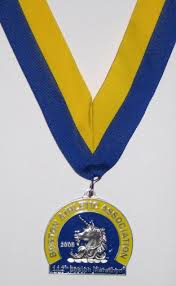
Someone puts a medal
around my neck and another young volunteer wraped a blanket around my shoulders
and undid my shoelaces to retrieve the official chip that recorded my progress
along the entire route. I staggered into a large tent where I retrieved my bag
to enjoy the relative warmth and eat bagels and drink more fluids. I could
hardly walk… around me hundreds of people, many with tears in their eyes from
joy of finishing, from pain, or from both; hundred of marathon winners, each
with own stories and reasons for running. The fact that the fastest runners
crossed the line some two and half hours before us didn’t mean anything at all
to me or to those around me, we were each in our own totally private race surrounded
by thousands others with their own private races and we all won!

The Marathon in Boston has a special place, it is the world
oldest marathon, it is held on this special holiday, that only we celebrate, it
is the beginning, the real beginning of spring after our long harsh winter, it
is school holiday week. But perhaps, most importantly, it is the personal
stories that lead thousands of people to run, it is the amazing carnival
atmosphere all the way from Hopkinton down to the finish line at Copley Square.
It is a day of celebration and festivities, celebrating our ability, us ….we
ordinary human beings who will our bodies to do the extraordinary …it is a
celebration of our determination to defeat addictions or old bad habits, our
inner journeys to achieve our hopes and aspirations, positive aspirations for
no one runs a marathon for a mean or a negative reason. It is all about us, the
runners, our families, neighbors, our friends and the entire community come to
celebrate profoundly positive emotions and ideals.
A lot has been written about the brutality and cruelty of
the bombings and condemnations of the abhorrent act have appeared everywhere.
For many people outside of Boston it is still hard to appreciate what this
event means to us. I wanted to write my own account as an Egyptian American, a
Bostonian of my first Boston Marathon. I run the Boston Marathon twice more,
each time, for my own very personal stories and reasons. The thousands that run
on April 15, 2013 each had their own story, their own reasons for embarking on
their personal journeys to train for and to run the marathon, so did their
loved ones and the more than one million people that lined the streets along
the entire route.

Weeks after the tragedy, I think of the amazing young woman,
Katie Lynch, whose 26 step marathon required her to train, she did it to
motivate us to run. Her little fragile body never stopped her from finishing
high school and graduating from college and completing her very own little baby
marathon. She did all she could do with her God given body until she finally
passed away few years after I first saw her. This is what Boston Marathon
about, ordinary people willing their God given bodies to do something very extraordinary
and having their entire city will them on and celebrate with them. The bombing
of the Boston Marathon is ultimately an assault on our humanity … the best of humanity…..it
is a direct attack on the All Mighty God, the creator of these bodies, and it
can never, never be of Him or in his Name.
AA
April 27, 2013